
Comparison of Voluntary Opening and Closing Terminal Devices for Body-Powered Prostheses
This study investigates the functionality and efficiency of voluntary opening (VO) versus voluntary closing (VC) terminal devices in body-powered prostheses. Specifically, the Sierra 2-load hook (VO) and the APRL VC hook (with locked clutch) were compared in their ability to assist users in performing activities of daily life. The results highlight the operational differences whereby VO devices facilitate finger opening, while VC devices enable finger closure, demonstrating implications for user preference and task performance. Full study published in the Journal of Rehabilitation Research and Development.

Comparison of Voluntary Opening and Closing Terminal Devices for Body-Powered Prostheses
E N D
Presentation Transcript
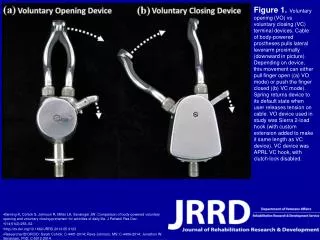
Figure 1. Voluntary opening (VO) vs voluntary closing (VC) terminal devices. Cable of body-powered prostheses pulls lateral leverarm proximally (downward in picture). Depending on device, this movement can either pull finger open ((a) VO mode) or push the finger closed ((b) VC mode). Spring returns device to its default state when user releases tension on cable. VO device used in study was Sierra 2-load hook (with custom extension added to make it same length as VC device). VC device was APRL VC hook, with clutch-lock disabled. • Berning K, Cohick S, Johnson R, Miller LA, Sensinger JW. Comparison of body-powered voluntary opening and voluntary closing prehensor for activities of daily life. J Rehabil Res Dev. • 014;51(2):253–62. • http://dx.doi.org/10.1682/JRRD.2013.05.0123 • ResearcherID/ORCID: Sarah Cohick: C-4401-2014; Reva Johnson, MS: C-4406-2014; Jonathon W. Sensinger, PhD: C-5012-2014