Download
1 / 4
40 likes | 174 Views
This document captures key insights and discussions from the roundtable held on June 9, 2002, featuring esteemed participants including Wayne Dai, Andrew Kahng, and industry leaders. The dialogue centered on significant challenges in VLSI design, particularly cost trade-offs, variability tolerances, and technology utilization in the context of 90nm and 100nm technologies. Emphasis was placed on the necessity of improved collaboration between academia and industry, enhancing education for analog and digital designers, and motivating research directions through knowledge sharing and innovative practices.

E N D
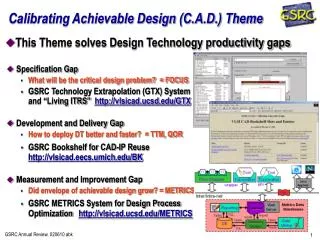
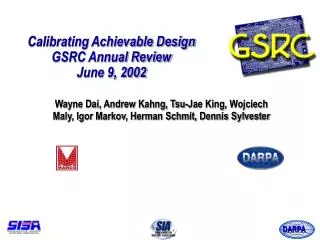
Calibrating Achievable Design Roundtable Discussion June 9, 2002 Wayne Dai, Andrew Kahng, Tsu-Jae King, Wojciech Maly, Igor Markov, Herman Schmit, Dennis Sylvester Facilitator: Bill Joyner, IBM/SRC
Attendees • Faculty • Herman Schmit, Wojciech Maly, Igor Markov, Dennis Sylvester, Andrew Kahng • Students • Michael Wang, Shuo Zhou, Bao Liu,, Stefanus Mantik, Yu Chen, Mike Oliver • Industry • Bill Joyner, Takahide Inoue, Simon Thomas, James Duley • Other Industry feedback • Sani Nassif
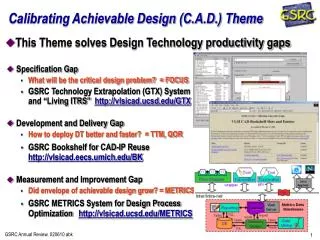
Discussion • What’s the big problem? • Cost tradeoffs need to be understood and modeled! • Comments: 5 cents / mm^2 cost with 90nm technology and 300mm wafers. Reference fab may be constructed and available; possibly available to GSRC? • Variability • What variability is tolerable? (This may be a sub-text to cost.) • Technology utilization • E.g., How to best use 100nm • Comment: we need a utilization vision, not just a technology vision (power? pin-limited?) • Sharing of information (across industry, across academia, across industry-academia) • E.g., shortage of qualified (analog) designers, and the issue of VLSI design education • Comment: Sometimes design is limited by design talent, but the product still gets out (available talent is applied as best it can…) • Is the solution education? (Re-education of old analog designers, education of digital designers in analog issues)
Discussion • What’s being done well? • Knowledge management for CAD and other concepts • Seeding and promoting ideas (collaboration, metrics, open-source) for the participants and within the GSRC and other centers • Motivating and justifying research directions for the other themes. • What could be improved? • Improved avenues for sharing data (esp. fab data) in addition to algorithms • Pushing others to use and adopt the Bookshelf • Become THE source of benchmark design examples and algorithm data • Explore and identify the future applications that will drive silicon consumption