Download
1 / 16
160 likes | 263 Views
Cotton is a vital plant cultivated for centuries, thriving in regions rich in sunshine, water, and fertile soil. This exploration reveals the history of cotton, from its wild origins to its role in the cotton industry. Key figures like Eli Whitney and innovations such as roller spinning shaped its production. The Cotton Belt across Southern U.S. states illustrates its agricultural significance, with Texas leading in production. Discover how cotton transforms into everyday products like jeans, sheets, and t-shirts, demonstrating its economic and cultural impact.

E N D
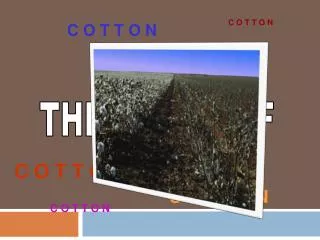
C O T T O N C O T T O N THE STORY OF C O T T O N C O T T O N
How do they make…? • Jeans • Sheets • Shirts
Basic Facts • Cotton is a plant • It grows wild in many places on the earth • Has been known cultivated and used by people of many lands for centuries • Cotton needs lots of sunshine, water and fertile soil • The boll weevil is the primary insect enemy of cotton
Types of Cotton • Egyptian • Sea Island • American Pima • Asiatic • Upland
People in History • Lewis Paul and John Wyatt • Roller spinning machine 1738 • Samuel Slater • First US. cotton mill 1790 • Eli Whitney • cotton ginin 1793
The Cotton Belt Millions of acres of cotton grow across the Southern United States
Alabama • Arizona • Arkansas • California • Georgia • Louisiana • Mississippi • Missouri • North Carolina • Oklahoma • South Carolina • Tennessee • Texas • Virginia US Cotton States Upland cotton
Arizona • California • New Mexico • Texas US Cotton States Pima cotton Some cotton is also grown in Florida, Kansas and New Mexico.
Leading Cotton Production Texas, which annually grows about 4.5 million bales of cotton, is the leading cotton producing state.
A Bale of Cotton • 55 inches tall • 28 inches wide • 21 inches thick • 500 pounds • 313,600 $100 bills • 215 Jeans • 249 Bed Sheets • 690 Bath Towels • 1,217 Men's T-Shirts • 1,256 Pillowcases • 1,085 Diapers