Download
1 / 20
200 likes | 327 Views
This analysis explores the transformation of societies from preindustrial to industrial and post-industrial, highlighting the shift in cultural practices. Folk culture, traditionally stable and community-oriented, faces rapid change and potential disappearance in the face of modernity and globalization. We examine the characteristics of preindustrial societies, including hunting and gathering, pastoral, and agricultural methods, as well as the rise of popular culture. Understanding these dynamics is crucial for recognizing the implications for cultural identity and community cohesion in our rapidly evolving world.

E N D
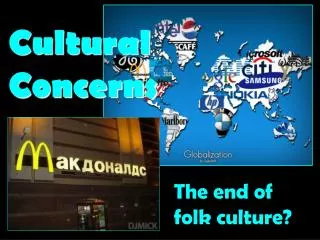
Cultural Concerns The end of folk culture?
Part I: Societies • Group: • Set of people who interact on the basis of shared expectations and who possess some degree of common identity • The largest and most complex groups that sociologists study are societies • Preindustrial vs. Industrial/Post-Industrial • \
Part 2: Preindustrial • Definition: • Food production is carried out through human and animal labor • Food production is main economic activity • \
Preindustrial • Types of Preindustrial Societies: • Hunting and Gathering • Pastoral • Horticultural • Agricultural • Gemeinschaft (community); characterized by mechanic solidarity • \
Preindustrial • Practice Folk Culture: • Practiced by small, homogenous, rural groups living in relative isolation • \
Folk Culture • Folk Culture is RAPIDLY changing and/or disappearing throughout much of the world
Characteristics: Folk Culture • Stable & close knit • Generally rural • Tradition rules • Resistant to change • Buildings erected without architect or blueprint; locally available building materials
Folk Food How did such differences develop?
Folk Architecture • Effects on Landscape: • Usually of limited scale and scope
Industrial Postindustrial • Definition: • Much of the economy is involved in providing information and services • \ • Definition: • Emphasis shifts from production of food to production of manufactured goods • Most production is carried out by machines • \
Postindustrial Industrial • Effects: • Higher standard of living • Strong emphasis on science/education • Technological advances • Emphasis on social equality and democracy • Effects: • New technology • Increase in population • Urbanization • \ • Gesellschaft (society); characterized by organic solidarity • Popular Culture
Popular Culture • Definition: • Found in a large, heterogeneous society that shares certain habits despite differences in personal characteristics • \
Characteristics: Pop Culture • Wide Distribution: • Differences from place to place uncommon; differences in one place over time are more likely • Housing: • Only small regional variations; trends over time
Characteristics: Pop Culture • Food: • Franchises, cargo planes, superhighways & freezer trucks have eliminated local variation
Pop Culture: Effects on… • Effects on Landscape: • Breeds homogenous, “placeless” landscape • Complex network of roads & highways • Commercial structures trend towards “boxes” • Planned & gated communities increasingly common
Pop Culture: Effects on… • Disconnect with landscape: • Indoor swimming pools, desert surfing
Is this the end of Folk Culture? • http://www.youtube.com/watch?v=As3pWXoq_as&feature=related