Download
1 / 21
220 likes | 349 Views
This informative resource details various flooring systems, including lumber sizes, common lengths, and materials such as pressure-treated lumber for sills and joists. It covers the structural roles of joists, trusses, and girders, as well as their configurations and spacing. The guide explains the significance of bridging, I-joists, and LVLs in construction, highlighting considerations for subflooring and crawl space ventilation. Essential for builders and homeowners, this guide ensures proper support and material choices for durable floor systems.

E N D
Lumber sizes Common lengths 8’, 10’, 12’, 14’, 16’
Sill • Structurally graded according to knots (size, tightness, placement), wane, and straightness • Must be pressure-treated lumber • Used as a transition between masonry and standard lumber • Anchor bolts embedded into masonry are commonly used to tie the sill to the foundation • Nails can be shot into concrete with a low-caliber nail gun
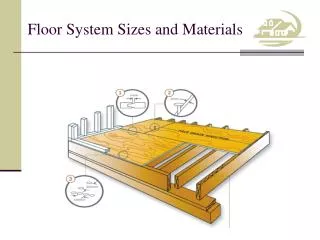
Joists • Provide support for floor • Wood or steel
Joists • Size of wood joists depends upon • Species of lumber • Wood grade • Spacing • 12”, 16”, or 24” O.C. spacing is most common • Works with the 48” module common to plywood and OSB
Joists • Recommended live load (40psf) • Distance between supports (clear span) • Joists manufacturer’s charts
Joists • Double joists must be provided under walls running parallel to the joist direction • May be solid or built up of two joists • May be solid or built up of two joists
Joists • Bridging • May be used between joists • Transfers the floor loads to adjacent joists • Stiffens joists • Aligns joists vertically • May be diagonal wood members, metal or 1x3 wood cross bridging • May be solid blocking placed perpendicular between joists
Wood Floor Trusses • May be used in place of solid lumber joists to provide support for the floor • Able to span longer distances than solid lumber joists • Reduce or eliminate the need for girders, piers, and columns • Allow for designing open spaces • Formed with top and bottom horizontal chords and diagonal webs constructed of standard size lumbers
Wood Floor Trusses • Typically placed 24” O.C. • Open web construction • Reduces sound transmission through floors • Aids in ease of plumbing, electrical, and heating systems installation • Sizes are determined from manufacturers’ charts
Wooden I-Joists • Similar to wood floor trusses • May be used in place of solid lumber joists to provide support for the floor • I-joists are able to span longer distances than solid lumber joists • Speed construction • Very straight • May come with circular knock-outs
Wooden I-Joists • Formed with horizontal wooden (solid lumber or micro lam) top and bottom flanges, grooved to receive a solid plywood or OSB vertical web
Joist Header • Used as rim joists with I-joist construction • Can be used with truss construction • Should be strapped to the sill in high wind areas • Double under exterior walls parallel to joist direction
Girders (Beams) • Built-up • Formed with solid lumber nailed together • Built on the job • Glue laminated lumber (glulam) • Solid, 1x__ lumber, glued together under pressure • Graded according to appearance • Very strong • Able to span long distances
Girders (Beams) • Glulam (cont’d) • Disadvantages • Weight • Expense
Girders (Beams) • LVL (Laminated Veneer Lumber) • Glued veneers, similar to plywood • Advantages • High strength • Long spans • Disadvantages • Cost • Low moisture resistance causes delamination in high humidity
Girders (Beams) • PSL (Parallel Strand Lumber) • Composed of veneers cut into strands • Very strong • Allows long spans
Girders (Beams) • Girder size • Determined by • Type of material used • Loads imposed • Clear span of the girder • Where loads exceed material limits, the girder span must be reduced by using piers, piles, columns, or posts
Subflooring • Provides a base for the underlayment and/or finish flooring material • Underlayment is material placed under finish floor coverings (i.e. as carpet, to provide a smooth, clean surface) • Underlayment can be combined with the subfloor into a single thickness • Single thickness underlayment/subfloor is generally constructed of ¾” tongue and groove plywood
Subflooring • Materials • Tongue and Groove Plywood 4’x 8’ sheets speed the installation, glued and screwed.
Crawl Space Considerations • Access door is required • Recommended size 24” wide x 18” high • Large enough to allow for repair and/or replacement of under-house mechanical systems • Ventilation provided • Removes moisture from crawl space • 8”x 16” vents are common