Download
1 / 24
240 likes | 375 Views
This comprehensive guide addresses the pressing issue of distracted driving, highlighting its dangers and providing strategies to reduce distractions while driving. Ideal for teens and commercial drivers, it emphasizes the need for awareness and education. Key statistics reveal that distracted driving is the largest contributor to traffic crashes, leading to thousands of injuries and fatalities each year. By understanding the types of distractions—visual, manual, and cognitive—drivers can adopt safer practices, such as using hands-free devices responsibly and focusing on the road.

E N D
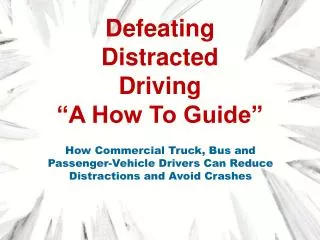
Defeating Distracted Driving“A How To Guide” Open Dialogue With Teens Teens & Trucks An Important Ingredient How Commercial Truck, Bus and Passenger-Vehicle Drivers Can Reduce Distractions and Avoid Crashes
Defeating Distracted Driving Facts about Distracted Driving and the Crashes It Can Cause
Distracted Driving: • Is the single largest contributing factor to traffic crashes today
Distracted Driving: • Is involved in 20% of all on-highway crashes • Led to 6,000 traffic deaths and a half million injuries in 2008 - a 20% increase from 2004
Distracted Driving: • Is as dangerous as impaired driving and other unsafe driving behaviors • No one is immune; even police officers can become distracted on the road
DistractedDriving: Distracted driving is abigger problem than just texting and cell-phone use!
Distracted Driving: However……a leading study by Virginia Tech Transportation Institute showed that truck drivers who texted while the vehicle was moving were 23 TIMES more likely to be involved in a crash Or near-crash incident!
Distracted Driving: • “No-texting” laws and ordinances have some effect if enforced • Many states allow police to cite a driver for “inattention” on the road • Reducing distracted driving is best done through awareness, education and changing driver behavior
Distracted Driving: • Glancing away from the road for more than one second can lead to a damaged bumper, a few dents …OR a devastating crash
Distracted Driving: • During a 3-second glance at a cell phone or other device, a vehicle traveling 55 mph will move approximately 250 feet down the road, or nearly the length of a football field!
UnderstandingDistracted Driving Three types of distractions: • Visual distractions • Manual distractions • Cognitive distractions
Distracted Driving: Visual Distraction: Anything that shifts a driver’s eyes away from the road to something unrelated to the primary task of driving EXAMPLES: billboard, accident scene, looking at street signs
Distracted Driving: Manual Distraction: Anything that causes a driver to remove one or both hands from the wheel or other driving controls EXAMPLES: eating, tuning the radio, programming a GPS, texting or dialing a cell phone
Distracted Driving: Cognitive Distraction: Anything that takes a driver’s mind, thoughts or mental attention away from the task of driving EXAMPLES: anger, anxiety, fatigue, pain or worry
Distracted Driving: Nearly all crashes in which distracted driving is a contributing factor usually involve a combination of two or all three types of distractions!
Reducing Distractions: • Adjust mirrors, instrument panel lighting, knobs and dials BEFORE entering the traffic flow • Get directions or program your GPS before putting the truck or bus into gear
Reducing Distractions: • Take care of all paperwork before you start on your trip • Eat a healthy meal BEFORE you start your trip, or pull completely off the road to eat or drink before resuming your trip
Reducing Distractions: • Perform short, frequent scans of mirrors and instruments, but keep the road ahead as your primary focus • Limit glances away from the road to less than one second
Reducing Distractions: • Cell Phone Use • ‘Hands-free’ cell phones that require you to manually dial a number are not substantially safer than ‘hand-held’ cell phones • Any cell phone use divides the driver’s attention from the driving task
Reducing Distractions: • Cell Phone Use • Voice-activated systems merely reduce visual and manual distractions, but not cognitive distractions • Make calls before you leave, then turn off your cell phone or let calls go to voice mail while the vehicle is moving
Reducing Distractions: • Cell Phone Use • NEVER text or email while driving!
Defeating Distracted Driving Developed in cooperation with: And a coalition of commercial truck and bus companies, driver educators and safety organizations.
For more information about Defeating Distracted Driving www.defeatingdistracteddriving.org