Explore Anticapitalist Critique: CARE Project Meeting & Film Screenings - April 16
Join us for the CARE Project Meeting on April 16. Please provide names of attendees. Office hours today are by appointment from 11 AM to 1 PM, and Monday, April 15 from 11 AM to Noon. Come prepared to discuss the complexities of an anticapitalist critique that intersects with race, gender, class, and labor. Attend our film screenings at the Arts Library, featuring "Maquilapolis" on April 17, "We Don’t Play Golf Here" on April 19, and "Maid in America" on April 22. Engage with questions about narratives, testimonies, and the tension between transnational issues and local contexts.

Explore Anticapitalist Critique: CARE Project Meeting & Film Screenings - April 16
E N D
Presentation Transcript
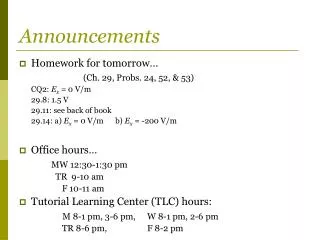
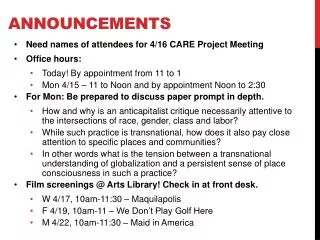
announcements • Need names of attendees for 4/16 CARE Project Meeting • Office hours: • Today!By appointment from 11 to 1 • Mon 4/15 – 11 to Noon and by appointment Noon to 2:30 • For Mon: Be prepared to discuss paper prompt in depth. • How and why is an anticapitalist critique necessarily attentive to the intersections of race, gender, class and labor? • While such practice is transnational, how does it also pay close attention to specific places and communities? • In other words what is the tension between a transnational understanding of globalization and a persistent sense of place consciousness in such a practice? • Film screenings @ Arts Library! Check in at front desk. • W 4/17, 10am-11:30 – Maquilapolis • F 4/19, 10am-11 – We Don’t Play Golf Here • M 4/22, 10am-11:30 – Maid in America
Language & action Beyond Master’s tools & master’s house
Culture as mediation, pt 1 • Narrative, testimony, oral history as powerful cultural forms of mediation because they enable understanding of individual subjectivity and larger social forces (156) • Cannot be valorized as transparent record of reality – reveals subjectivity of individual • Cannot be dismissed either as completely relative fiction – grounded in material experience of larger social forces • Cannot be solely reduced to individualistic experience • Cannot be seen as totally determined by larger social forces either
Culture as mediation, pt 2 • Narrative, testimony, & oral history make possible alternative frameworks of “politicization” (Lowe 158) • “The particular location of racialized working women at an intersection where the contradictions of racism, patriarchy, and capitalism converge produces a subject that cannot be determined along a single axis of power or by a single apparatus, on the one hand, or contained within a single narrative of oppositional political formation, on the other” (Lowe 164)
Discussion questions • According to AudreLorde, what are “the master’s tools”? What is the “master’s house”? And why can’t those tools be used to dismantle that house? • Why does Lowe insist that an attention to “difference” as evoked by AudreLorde’s speech on “Master’s Tools” is crucial for Asian immigrant and Asian “American” women? • How do the narratives, testimonies, & oral histories of Asian “American” women transform silence into language and action?