Download
1 / 17
200 likes | 333 Views
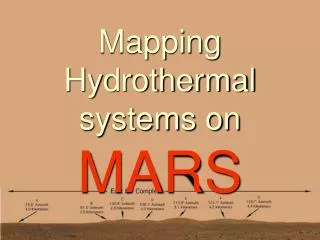
This presentation by Adrian Brown, a PhD student at the Australian Centre for Astrobiology, discusses the relevance of investigating ancient hydrothermal systems on Earth, particularly in the Pilbara region of Western Australia, to astrobiological research on Mars. With findings of 3.5 billion-year-old stromatolites as signs of early life, this research aims to apply hyperspectral mapping techniques to remotely detect hydrothermal alteration minerals. The talk includes insights from advanced spectrometers, such as the Mini-TES, and explores their future applications in Mars exploration.

E N D
Presentation Overview • Hyperspectral Mapping Project Background • Signs of early life – Pilbara, WA • SWIR Mapping of a Stromatolite horizon • Relevance to Mars • Latest results with the Mini TES instrument
Who am I? • Adrian Brown • PhD student at the Australian Centre for Astrobiology (ACA), Macquarie University • Supervisors are Prof. Malcolm Walter, Director of the ACA, and Dr. Tom Cudahy, CSIRO • Thesis topic – Mapping Ancient Hydrothermal Systems on Earth and Mars
Signs of early life – Pilbara, WA • ACA scientists are investigating the ancient Pilbara region of northern Western Australia • 3.5 billion years old • Contains first signs of life on Earth in the form of stromatolites • Could be a good analogue for Mars
SWIR Mapping of Stromatolite Outcrop • Aims: • Can we remotely detect and identify hydrothermal alteration minerals in a site of astrobiological interest? • Can we put stromatolite occurrences in mineralogical context using SWIR mapping? • Can rovers automatically identify minerals for us? • Is this technique of use on Mars?
SWIR Spectrometry Sun • A spectrometer splits up light into different colours • By graphing colour intensities we can record a characteristic spectral response of rocks Collector Infrared Red Rock Sample Yellow Diffractometer Blue Ultraviolet
Tools of the trade • PIMA • GPS enabled Pocket PC
MER Instruments PANCAM – panoramic camera Mini TES – thermal emission spectrometer Magnetic Arrays APXS – alpha particle x-ray spectrometer Mossbauer – fe spectrometer MI – microscope imager RAT – rock abrasion tool
Silicates CO2 Carbonates