Understanding Binary Heaps: Operations and Properties for Priority Queues
This chapter provides a thorough examination of binary heaps and their implementation in priority queues. It defines key concepts such as priority queues, the unique structure of binary heaps, and the importance of complete binary trees. The chapter covers essential operations, including insertion and deletion of the minimum element, emphasizing their logarithmic time complexity. Additionally, it elaborates on the heap-order property and the efficient buildHeap operation that can construct a binary heap in linear time, making it a practical choice in various computational scenarios.

Understanding Binary Heaps: Operations and Properties for Priority Queues
E N D
Presentation Transcript
Chapter 21The Binary Heap Bernard Chen Spring 2006
Problem: find MIN and Delete • Possible methods: • unsorted array • sorted array • Binary Search tree
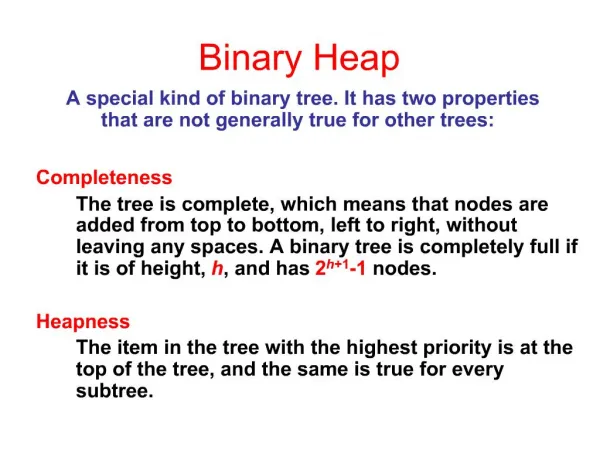
What’s Binary Heap • The Binary Heap supports the insertion of new items and delete of MIN item in logarithmic worst-case time. • It uses only an array to implement. (Instead of linked list) • It is the classic method used to implement priority queues
Structure Property • A COMPLETE BINARY TREE is a tree that complete filled.
Advantages of Complete Tree • The height of a complete binary tree is at most logN • Left and right pointers are not needed
Advantages of Complete Tree • The parent is in position i/2 • The left child is in position 2i • The right child is in position 2i+1
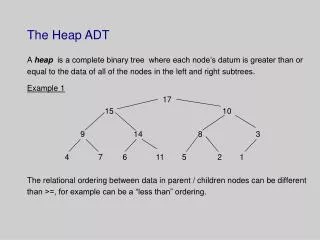
Heap-Order property • In a Heap, for every node X with parent P, the key in P is smaller than or equal to the key in X
21.2 Implementation of the Basic Operations • Insert operation • Delete operation
21.2.1 The INSERT operation • Insertion is implemented by creating a hole at the next available location and then percolating it up until the new item can be placed in it without violating a heap order. • Insert takes constant time on average but logarithmic time in worst case.
21.2.2 The DeleteMIN Operation • Deletion of the min involves placing the former last item in a hole that is created at the root. • The hole is percolated down the tree through min children until the item can be placed without violating the heap order property.
21.3 the buildHeap Operation:Linear-Time Heap construction • The buildHeap operation can be done in linear time by applying a percolate down routine to nodes in reverse order