Mineral Identification
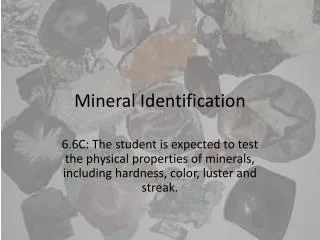
Mineral Identification. Chapter 3 Section 3. Minerals can be identified by their physical characteristics. The physical properties of minerals are related to their chemical composition and bonding. (That’s why we reviewed bonding). Introduction.

Mineral Identification
E N D
Presentation Transcript
Mineral Identification Chapter 3 Section 3
Minerals can be identified by their physical characteristics. • The physical properties of minerals are related to their chemical composition and bonding. • (That’s why we reviewed bonding) Introduction
Mineralogists are scientists who study minerals. • One of the things mineralogists must do is identify and categorize minerals. • most are recognizable using physical properties. • Color • Streak • Luster • Specific gravity • Hardness • Cleavage • Fracture How are minerals identified
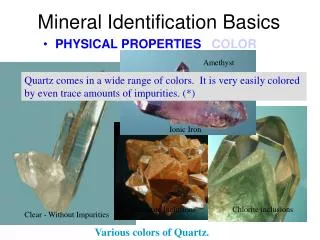
Color is rarely very useful for identifying a mineral. Different minerals may be the same color. • The same mineral may also be found in different colors. Gold and Pyrite Quartz Color, Streak, and Luster
Streak is the color of a mineral’s powder. • Streak is a more trustworthy property than color because streak does not vary. • Minerals that are the same color may have a different colored streak. • To check streak, scrape the mineral across an unglazed porcelain plate Color, Streak, and Luster
Luster describes the reflection of light off a mineral’s surface. • Luster can be classified as metallic and non-metallic. • Metallic minerals are opaque and shiny Color, Streak, and Luster
Nonmetallic minerals Color, Streak, and Luster
The specific gravity of a substance compares its density to that of water. • Density = mass/volume • Substances that are more dense have higher specific gravity. Specific Gravity
Hardness is a measure of whether a mineral will scratch or be scratched. Mohs Hardness Scale. • Mohs Hardness Scale: 1 (softest) to 10 (hardest). Hardness
Breaking a mineral breaks its chemical bonds. Since some bonds are weaker than other bonds, each type of mineral is likely to break where the bonds between the atoms are weaker.. • Cleavage is the tendency of a mineral to break along certain planes to make smooth surfaces. • Fracture is a break in a mineral that is not along a cleavage plane. Cleavage and Fracture
Fracture Cleavage Cleavage and Fracture