Understanding Bases: pH, Hydroxides, and Their Properties
Explore the fundamental concepts of bases in chemistry, focusing on how they generate hydroxide ions (OH-) in water. Learn about the Arrhenius and Brønsted definitions of bases, the distinction between strong and weak bases, and the relationships between pH and pOH. We also address common questions about the presence of pH in bases lacking H+, interactions in aqueous solutions, and how to calculate pH using [H+] and [OH-] concentrations. Uncover the nuances and complexities of base behavior in various chemical contexts.

Understanding Bases: pH, Hydroxides, and Their Properties
E N D
Presentation Transcript
Bases Who's on first?
Back to Our Color-Coded Scale What about the right-hand side of this?
Some Questions 1. If pH comes from [H+], how do you have a pH in base, which doesn't have any H+? 2. What makes something a base in the first place?
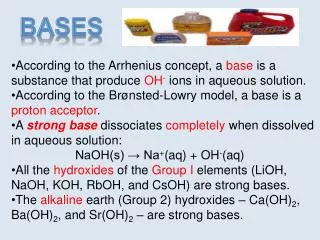
Once Again, in Reverse 2. What makes something a base in the first place? Arrhenius: makes OH- when put in water Bronsted: gets an H+ Two ways to make OH- in water:
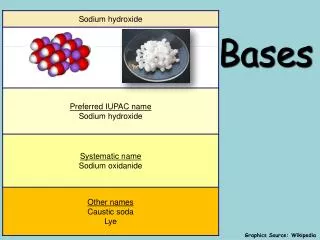
Once Again, in Reverse 2. What makes something a base in the first place? Arrhenius: makes OH- when put in water Bronsted: gets an H+ Two ways to make OH- in water: 1. Just put some hydroxide in! NaOH, or Ca(OH)2, or KOH... (note: these must be ionic, or it's not really OH-. CH3OH is not a base)
Once Again, in Reverse 2. What makes something a base in the first place? Arrhenius: makes OH- when put in water Bronsted: gets an H+ Two ways to make OH- in water: 1. Just put some hydroxide in! NaOH, or Ca(OH)2, or KOH... (note: these must be ionic, or it's not really OH-. CH3OH is not a base) 2. Pull an H+ off water to turn it into OH-: • B- (aq) + H2O (l) → HB (aq) + OH- (aq)
Strong vs Weak 2. Pull an H+ off water to turn it into OH-: B- (aq) + H2O (l) → HB (aq) + OH- (aq) Just like with acids, you can have strong and weak bases. Strong ones do this reaction 100% Common strong bases: OH- , O2-, H-, and NH2-
Strong vs Weak 2. Pull an H+ off water to turn it into OH-: B- (aq) + H2O (l) → HB (aq) + OH- (aq) Just like with acids, you can have strong and weak bases. Strong ones do this reaction 100% Common strong bases: OH- , O2-, H-, and NH2- There's one tricky thing with oxide, though, if we write the equation out: O2- (aq) + H2O (l) → OH- (aq) + OH- (aq) You end up with two hydroxides. This will be relevant later.
Back to Question 1 1. If pH comes from [H+], how do you have a pH in base, which doesn't have any H+? This goes back to the acids video: [H+]*[OH-] = 10-14 While both are 10-7 M for neutral water, this equation is always true. So if we add a bunch of base, the [OH-] will be higher, so [H+] wil be lower. Example: 0.1 M NaOH [OH-] = 0.1 M • [H+]*0.1 = 10-14 [H+] = 10-13 • pH = -log(10-13) = 13
A “Shortcut” Method • Example: 0.1 M NaOH [OH-] = 0.1 M • [H+]*0.1 = 10-14 [H+] = 10-13 • pH = -log(10-13) = 13 If we define pOH to be like pH: pOH = -log[OH-] Then using some algebra, we get: pH + pOH = 14 So back to the same example: 0.1 M NaOH [OH-] = 0.1 M • pOH = -log(0.1) = 1 pH + 1 = 14 pH = 13
Two places where you can run into trouble: • 1. Some hydroxide compounds have more than one hydroxide: • If I make 0.1 M Ca(OH)2, the [OH-] = 0.2 M • 2. Remember the thing about oxides? This is where it comes up” • If I make 0.1 M Na2O, the [OH-] = 0.2 M
Summary • Bases make OH- in water, either by being OH-, or getting an H+ • Strong bases completely pull H+ off water • OH-, O2-, H-, and NH2- are the most common strong bases • pOH = -log[OH-] • Use pH + pOH = 14 or [H+]*[OH-] = 10-14 to get pH • BASE jumping is something else entirely.