Economics
This guide explores fundamental concepts of economics, including demand and supply dynamics, elasticity metrics, and market functions. It defines demand as the quantity purchased at specific prices over time and supply as the quantity produced. The text covers the factors influencing demand and supply, the elasticity of demand in relation to price changes, and the income elasticity of demand. Additionally, it addresses economic issues like scarcity, opportunity costs, and the importance of labor in the market. Understanding these concepts is crucial for navigating economic systems effectively.

Economics
E N D
Presentation Transcript
Definitions: Section 1 • Demand: Quantity purchased at a given price over a period of time • Supply: Quantity produced at a given price over a period of time • Z elasticity of Y: %change Z/%change Y
Demand • Demand: Quantity purchased at a given price over a period of time • Change in disposable income • Taste • Price of substitutes and complements • Advertising
Supply • Supply: Quantity producers sell at a given price over a period of time • Costs of factors of production • Changes in technology • Changes in taxes and subsidies
PED • Responsiveness of demand to a change in price • % change in demand / % change in price • Horizontal line = perfectly elastic. Gentle slope = elastic. Steep slope = inelastic. Vertical line = perfectly inelastic. • SPLAT: • S: Substitutes • P: Proportion of income • L: Luxury or not • A: Addictive or not • T: Time to respond
PES • Responsiveness of supply to a change in price • % change in supply / % change in price • PES 1 = unitary. Change in price = change in supply • Affected by stock levels, production speed, spare capacity, ease of entry into the market
YED • Responsiveness of demand to changes in income • % change in income/ % change in price • Main factor: necessity or luxury • Normal goods: relationship between income and demand positive • Inferior goods: relationship between income and demand negative
Elasticity and Firms • PED and firms • PED inelastic = price and revenue relationship positive • Always try to make products inelastic • YED and firms • Long run benefits for firms, income increases = demand increases • Product switching: Firms switch to YED elastic products • Product planning: planning ahead in order to change your product to take advantage of elasticity
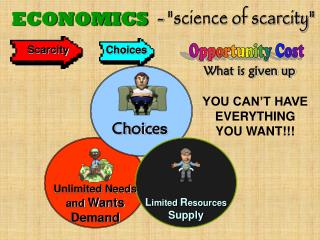
Resolving scarcity • Economic problem: there are infinite wants but finite resources • What to produce? How to produce? For whom to produce? • Opportunity cost: the cost of the next best alternative foregone • Choice: solution to the economic problem
Resolving scarcity cont. • Production Possibility Curves: Show the maximum combinations of goods and services that can be produced by an economy in a given time period. • PPC shift to the right = economic growth • An economy can produce consumer goods (goods purchased by households)or capital goods (goods used to produce other goods)
Mixed Economy • Efficiency • Measure of output per unit of input • Efficiency conserves scarce resources • Market Failure • When producers operate inefficiently • Can be caused by • Lack of competition • Missing market: some goods not provided by private sector (public/merit) • Lack of information • Factor immobility (factors move from one use to another)
Division of Labor • When production process is broken down into a number of components
Demand for Labor • Derived demand • Cost and availability of machinery/cheaper labor (substitutes) • Productivity • Costs other than wage rate (housing, insurance, uniform)
Supply for Labor • Working age • Participation of women • Age distribution • Net migration • Quality of labor • Education and training
Wage differences between occupations • Training/qualifications required • Physical risk/hours (terms and conditions) • Expanding industries • Public v private sector
Minimum Wage • Minimum Wage – the least amount of money that can be legally paid • Benefits disadvantaged workers • Reduces poverty • May cause unemployment
Trade Unions • Negotiate for better pay and conditions • Provide legal protection • Pass laws benefiting workers • Restricting of trade unions • Secret ballots • Closed shops banned • Businesses seek compensation • Strong trade unions force up wages in some markets
Factors of Production • Factors of Production: The resources used to create goods and services • Production: Total output. • Land • Labor • Capital: • Fixed • Working • Enterprise: Risk takers • Productivity: output per unit input (e.g. per worker, per worker per hour, per machine, etc)
Sectors of the Economy • Primary Sector – Extraction of raw materials • Secondary Sector – Manufacturing • Tertiary Sector – Services and retail
Deindustrialization • Developed economies shift from primary to tertiary production • Demand changes from goods to services • Competition from LEDCs forces MEDCs to shift to services • Machines reduce employment in manufacturing
Production Costs and Revenue • Fixed costs – do not change as output increases • Variable costs – vary as output increases • TC = FC + VC • AC = TC/Q produced • Revenue = PQ
Economies of Scale • Technical: Large firms can afford and use technology and machinery efficiently • Purchasing: bulk = cheaper rates • Marketing: in house delivery is cheaper than hiring • Financial: Larger loans = cheaper interest • Managerial: Specialist managers • Risk – bearing: Wider range of products, less risk
External and Diseconomies of Scale • External Economies – benefits from growth of industry • Skilled labor pool, infrastructure, ancillary services • Diseconomies of Scale • Bureaucracy – too many resources used in administration • Labor relations • Co – ordination and control
Productivity • Increases in productivity = PPC shift outward • Land: Fertilizer, GM crops, drainage, irrigation, infrastructure • Labor: • Quantity: Immigrant workers, increased birth rate • Quality: Education, motivation, improved working practices (job rotation) • Capital: Technology and machinery
Externalities • An impact on a 3rd party • Social cost = private cost + negative externalities • Social Optimum: Social Cost = Social Benefit • Dealing with externalities • Taxation • Legislation and regulation • Education and advertising on dangers of externalities • Subsidies encouraging positive externalities (job creation, training and education)
Competitive Markets • Rivalry for sales • Usually occurs when products are homogenous • Competition varies between industry • Perfect competition • Many buyers and sellers • Firms have little to no control over price • Many close substitutes • High levels of information • Low barriers to entry
Growth of Firms • Organic Growth – increasing market share and output • Mergers and Acquisitions • Horizontal – Same industry and stage of production • Vertical – Same industry, different stage of production • Lateral – Same products/services, do not compete • Conglomerate – Different industries
Motives and Limitations to Growth • Motives • Economies of scale • Increased market share • Diversifying • Limitations • Limited market • Lack of finance • Aims of entrepreneur • Diseconomies of scale
Monopoly • When the market is supplied by 1 firm • Monopolies set price or determine quantity • Demand is highly inelastic • Natural Monopoly – Market is more efficiently served by one supplier • High sunk costs – high initial investment. Usually caused by high infrastructure costs e.g. water and railways • Features • High barriers to entry • One dominant supplier • Unique products – no close substitutes
Oligopoly • A market dominated by a few large producers • Firms are interdependent • Price rigidity • Non – price competition
Public and Private Sector • Public sector – ministries, local services and government business organizations • Private sector – sole traders (single person), partnerships and companies (shareholders elect a board of directors)
Aims • Public sector • Community welfare • Provide services not provided by the private sector • Minimizing costs • Allowing for social costs and benefits • Private sector • Profit maximizing/satisficing • Survival • Growth
Government Regulation • Regulation is needed to restrict excessive market power • Regional Policy • Designed to solve regional problems. • Setup incentive (take jobs to workers) • Reduce income inequity • Reduce congestion
Competition Policy - UK • Methods of promoting competition • Encouraging the growth of small firms (free business advice, loan guarantees, profit tax breaks etc.) • Legislation – passing laws • Removing legal barriers to entry • Introducing anti-competitive legislation (UK Fair Trading act, Competition Act) • Organizations • OFT – determines competition policy, enforces consumer protection legislation, investigates suspected unfair trading • Competition Commission – investigates mergers/markets where consumers may be exploited, enforces policy and prosecutes • Example of enforcing legislation • UK government forced the corporation to sell 2/3 airports in London, had ruled they had been operating as a monopoly
Privatization • Transfer of assets from public to private • Methods • Issuing shares • Contracting out • Sale of land and property • Reasons • Create efficiency • Create income • Reduce political interference
Effect on Stakeholders • Consumers: Lower prices, better choice and quality. Loss in services • Workers: Extreme unemployment in the short run • Firms: Objectives shift from welfare to profit • Government: Loses control, gains income • Economy: Improved resource allocation due to efficiency
Macroeconomic Objectives • Economic Growth – GDP. Limitations include inflation, population and standard of living. Progresses as a cycle • Control of Inflation – Measured in RPI or CPI. Demand pull, cost push, or money supply. • Unemployment – cyclical, frictional, seasonal, voluntary • Balance of payments on the current account – trade of goods and services, deficit and surplus • Protection of the environment – regulation and taxation