Update on Categorization and Screening Meeting - June 1, 2023: Focus on Organics and Inorganics
50 likes | 163 Views
The June 1 meeting addressed the categorization of organics and inorganics, revealing that industry feedback is crucial for progress. Key topics included the need for rigorous categorization, improved coordination between the European Commission (EC) and Health Canada (HC), and ongoing assessments. Updated prioritization outlines and spreadsheets aim to fill data gaps, especially regarding UVCBs and polymers. The discussion emphasized international collaboration and proactive data generation, particularly for high severity and high certainty substances. Upcoming updates are scheduled for July.


Update on Categorization and Screening Meeting - June 1, 2023: Focus on Organics and Inorganics
E N D
Presentation Transcript
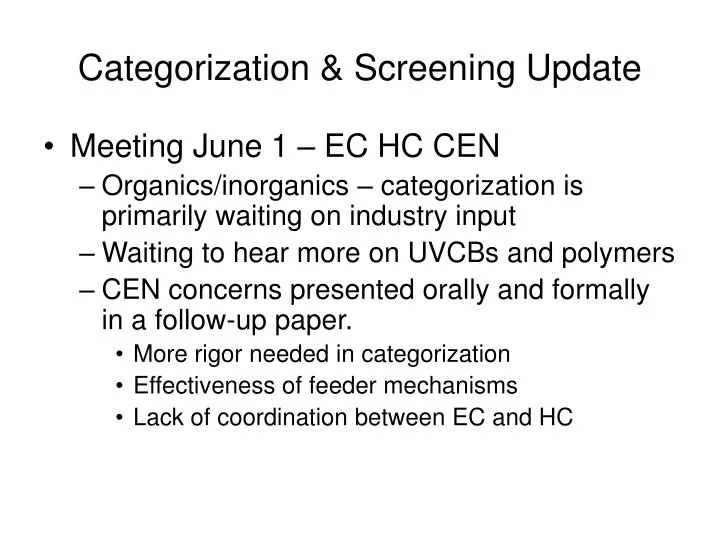
Categorization & Screening Update • Meeting June 1 – EC HC CEN • Organics/inorganics – categorization is primarily waiting on industry input • Waiting to hear more on UVCBs and polymers • CEN concerns presented orally and formally in a follow-up paper. • More rigor needed in categorization • Effectiveness of feeder mechanisms • Lack of coordination between EC and HC
June 1 meeting (cont’d) • Updated spreadsheets will continue through to categorization itself – next due in July • Updated ‘rainbow chart’ • Prioritization outline provided – generally positive • Overall timeline for SLRA over 2 decades – of concern to CEN
The Framework For Action On Substances Meeting Categorization Criteria Priority to Fill Data Gaps • Higher severity/ lower certainty • Fill information gap through science and monitoring • Actively engage international players (influence) • Challenge voluntary industry RM action, or data generation Priority for Assessment • High certainty & severity • Higher volume and or hazard • Precautionary RM action where needed Monitor Progress • Lower severity & certainty • Support voluntary industry activity to fill data gaps • Passively align with existing international data gathering or assessment activities (communicate) • Implement international feeder by monitoring RA/RM activities in other countries • Implement provisions to put onus on industry (S. 70 feeder) Low Priority for Action • Lower severity / higher certainty • Lower volume • Low priority for assessment • Generic exposure tools to set aside • Communicate low expectation for immediate action • Monitor 6 feeders
2005-2010 2011-2015 2016-2020 2021-2025 DONE-PSL1, 2 Ongoing Assessment • Main Feeders • Categorization • ~3400 in • P, B, iT • Volume ’86 • Use • International • HPV status • REACH 2009 • Research • Emerging science & monitoring • Industry • S. 70 • Voluntary actions Assess High Severity and High Certainty Organics, Polymers, UVCB Metals – several moieties Completed International HPV HC priorities ‘set aside’ Assess Sponsor HPV EC Priority to fill data gaps Data Generation - mandated 71(c) (other than HPV) High Severity, Low Certainty Government Research/Approaches [proposals, groups etc.] Industry Assess if necessary Data generation Monitor Progress Low Severity, Low Certainty Reverse-onus (S.70) Ongoing international programs Reverse-onus Exposure model implementation Set aside Assess Low Priority for Action – Low Severity, High Certainty Determine commercial status Set aside Data generation Reverse onus Set aside Assess Global Green, uncertain; data poor Wait for other jurisdictions until next 5 year period