Understanding Inscribed Angles and Their Theorems in Geometry
This resource provides a comprehensive overview of inscribed angles in geometry, highlighting key aspects such as their vertex location on the circle and the nature of their sides as chords. It discusses the Inscribed Angle Theorem, which states that the measure of an inscribed angle is half that of its intercepted arc. Additional insights include congruence of inscribed angles intercepting the same arc, the uniqueness of angles in semicircles, and properties of inscribed quadrilaterals. Examples are given for practical understanding and application.

Understanding Inscribed Angles and Their Theorems in Geometry
E N D
Presentation Transcript
Inscribed Angles Geometry H2(Holt 12-4) K. Santos
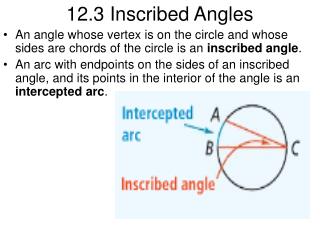
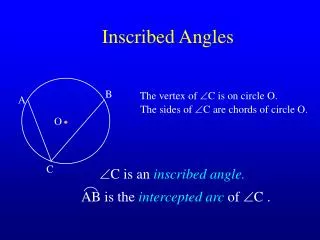
Inscribed angle Inscribed angle—an angle in the circle with its vertex on the circle and its sides being chords of the circle. A C B < C is and inscribed angle is the intercepted arc
Inscribed Angle Theorem 12-4-1 The measure of an inscribed angle is half the measure of its intercepted arc. X Y Z m < Y = ½
Example—Inscribed Angle Find the values of a and b. 32 b a
Example—Inscribed angles P a Find the values of a and b. T 30 60 S Q b R
Corollary to the Inscribed Angle Theorem 12-4-2 Two inscribed angles that intercept the same arc are congruent. A D B C <A and < D have the same intercepted arcs so, <A <D
Theorem 12-4-3 An angle inscribed in a semicircle is a right angle. M N P O < M has an intercepted arc of this arc is a semicircle So, m < M = 90 (1/2 of 180)
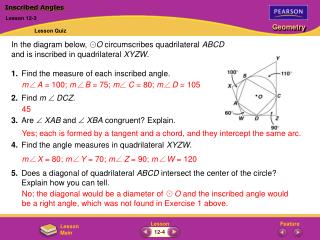
Theorem 12-4-4 If a quadrilateral is inscribed in a circle, then its opposite angles aresupplementary. A B C D < A and <C are opposite angles, so they are supplementary <B and <D are opposite angles, so they are supplementary
Example—Inscribed quadrilateral m < A = 70 and m < B = 120. Find m < C and m < D A B C D
Example—Inscribed Quadrilateral E Given m = 70, m = 80, and m 90. Find m < G and m <D. D F G