Download
1 / 12
120 likes | 228 Views
Explore the power struggles and successes of monarchies in France, England, and Spain during the Renaissance period, focusing on strong leaders like Charles VII, Louis XI, Edward VII, and the Tudor family. Learn about the strategies these monarchs employed to centralize power, control nobility, and achieve unity. Discover the political landscape, including the impact of wars, reforms, and societal changes, as absolute monarchs aimed for total control and the unification of their realms. Witness the challenges faced by countries like Spain, divided by internal conflicts and ethnic cleansing, and how they navigated towards governmental unity. Delve into the complex dynamics of Renaissance politics and statecraft, marked by intrigue, diplomacy, and the quest for power.

E N D
Introduction • Strong monarchies were important in terms of centralizing and consolidating power • Argument as to why 100 Years’ War lasted so long • Nobles had more power than king
Power Struggle • Inspired by Ren. ideas (of the Greeks and Romans), many monarchs of the 15th c. attempted to rebuild the strength of their power • Checked power of the nobles • Established peace in the country • Absolute monarchs: strong, total control was objective • “would rather be feared than loved” (Machiavelli) • France, England and Spain
France • 100 Years’ War destroyed France • Economically ruined • Land destroyed • Depopulated
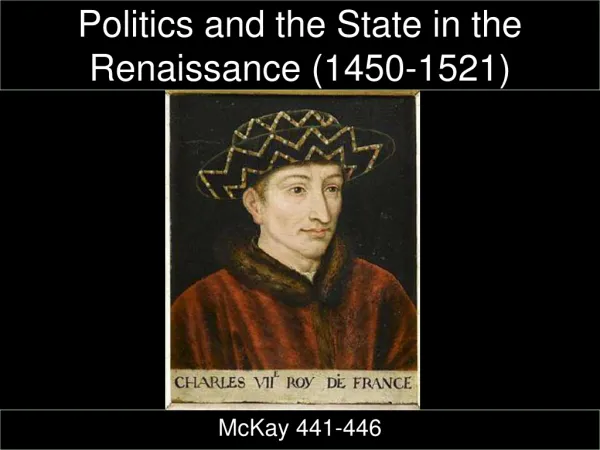
Charles VII • French monarchs of the day attempted to rebuild the country • Charles VII • Ended civil war • Increased royal revenue through taxes: $ • Built strong military (first permanent standing army) • Limited power of church over the state (Pragmatic Sanction)
Louis XI • He built upon the practices of his father • Unified all independent principalities • Increased taxation • Controlled nobility • Concordat of Bologna • Gave church some power back, but still allowed monarch to appoint church officials
England • Like France, England had suffered the effects of the Black Plague, 100 Years’ War, and civil war • War of the Roses, 1455-1471 • York family (white rose) and Lancaster family (red rose) • 2 branches of the Plantagenet Dynasty • Vied for succession to the throne • Edward VII (York) won the throne and attempted to establish peace
Edward VII • Main Focus of monarchs after Edward VII was to continue the time of peace in England and control the nobility • Richard III, Henry VII (Tudor family) • Monarchs used diplomacy to avoid wars with neighbors • Therefore, didn’t need to ask Parliament (legislative body, made up of nobles) for money • Royal Council: Middle class officials that helped king manage countryside
The Tudors • Tudor Family (Henry VII and descendants) used local officials to help control country at local level • Focused on concerns of the middle class= popularity • Effectively created peace, rebuilt the strength of the monarchy and economy • No standing army
Spain • Spain, like Italy, consisted of smaller, independent kingdoms (each with their own rulers) • For many years, the Iberian Peninsula (what is now Spain and Portugal), had a common goal to reconquer (reconquista) the peninsula from the Moors (Muslims) and Jews
Government Problems • Problem is that Spain is too divided • No governmental unity • Marriage of Isabella of Castile and Ferdinand of Aragon was an attempt unify the peninsula • Ferd and Bella had trouble with aristocracy (nobles) • hermandades: local councils of middle class people who helped with local control • Controlled church • Could tax church and appoint church officials
Ethnic Cleansing • 1492, Granada (southern Spain) was defeated • Last Muslim stronghold • Columbus was sent out that same year • Jews • Many Jews in Spain had control of money, good jobs; led to jealousy • Forced to convert or leave • Converts were called new Christians • Inquisition was created to determine if conversions were real • One religion was important in fully controlling country • 1580, peninsula was fully unified