Understanding Newton's Law of Universal Gravitation
Learn the simplest calculations for objects near Earth's surface and how gravitational force varies with distance. Explore proportional relationships and examples to grasp the concept better.

Understanding Newton's Law of Universal Gravitation
E N D
Presentation Transcript
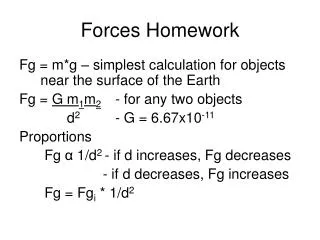
Forces Homework Fg = m*g – simplest calculation for objects near the surface of the Earth Fg = G m1m2- for any two objects d2 - G = 6.67x10⁻¹¹ Proportions Fg α 1/d2 - if d increases, Fg decreases - if d decreases, Fg increases Fg = Fgi * 1/d2
1. Fg = m*g Fg = 4.5 kg*9.8 N/kg = Newtons 2. Fg = m*g 167 N = m*9.8 N/kg m = 167N/9.8 N/kg m = kg 3. Fg = m*g 408 N = 250 kg * “g” g = 408N/250 kg g = N/kg or m/s2 P 93
Fg1 = d22 Fg2d12 700 N = 102 x 12 Fg = N 2. a. Fg = m*g = 1x105 kg * 9.8 N/kg = N b. 128000 = 20 x as far as in 6400 part a Fg1 = d22 Fg2d12 Fg = N 30 times as far (1/302) Really far (9x10¹¹ times as far away) 1/d2 = ?? P. 96
3. Fg1 = d22 Fg2d12 50000N = (1/4)2 x 1 = 50000 /(1/16) = 50000 * 16 = N 4. Fg1 = d22 Fg2d12 How has d changed? Initial: di = 6400 km Now: df = 6600 km So df/di = 6600/6400 = x larger Fg2 = 9.8 N/kg * 1/1.032 = 9.8 * 1/1.06 = N/kg P 96
Fg = G m1m2 d2 = 6.67x10⁻¹¹(60)(70) 12 = N 2. Fg = G m1m2 d2 =6.67x10⁻¹¹(2000)(2000) 2.52 = N P 98
a. ME = 6x1024 kg Fg = G m1m2 d2 = 6.67x10⁻¹¹(6x1024)(1) (20,000,000m)2 = N b. 20,000 / 6400 = 3.13 times the radius of Earth Fg = Fgi * 1/d2 = 9.8N * 1/(3.13)2 = 9.8N * 1/9.797 = N P 98 # 3 – two solutions