Download
1 / 41
410 likes | 531 Views
This paper discusses advancements in ray tracing techniques using stream filtering, emphasizing the implementation of wide SIMD operations to enhance performance in interactive rendering environments. The approach focuses on applying a series of filter operations to groups of rays, improving SIMD efficiency by eliminating inactive rays and achieving significant performance gains. Key concepts include the formulation of input and output streams, boolean masks for partitioning, and the integration of filtering during the traversal, intersection, and shading stages of ray tracing.

E N D
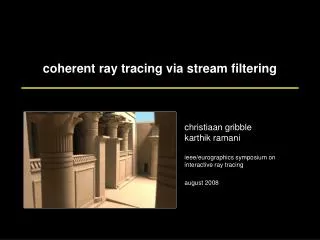
coherent ray tracing via stream filtering christiaan gribblekarthikramani ieee/eurographics symposium on interactive ray tracing august 2008
acknowledgements • early implementation • andrewkensler (utah) • ingowald (intel) • solomonboulos (stanford) • other contributors • steve parker & pete shirley (nvidia) • al davis & erikbrunvand (utah)
wide SIMD environments • ray packets SIMD processing • increasing SIMD widths • current GPUs • intel’slarrabee • future processors how to exploit wide SIMD units forfast ray tracing?
stream filtering • recast ray tracing algorithm • series of filter operations • applied to arbitrarily-sized groups of rays • apply filters throughout rendering • eliminate inactive rays • improve SIMD efficiency • achieve interactive performance
core concepts • ray streams • groups of rays • arbitrary size • arbitrary order • stream filters • set of conditional statements • executed across stream elements • extract only rays with certain properties
core concepts input stream a b d e f c test conditional statement(s) stream element out_stream filter<test>(in_stream) { foreach e in in_stream if (test(e) == true) out_stream.push(e) return out_stream }
SIMD filtering • process stream in groups of N elements • two steps • N-wide groups boolean mask • boolean mask partitioned stream
SIMD filtering input stream a b c d e f test boolean mask step one
SIMD filtering input stream a b c d e f test a b c boolean mask t t f step one
SIMD filtering input stream a b c d e f test d e f boolean mask t t f t f t step one
SIMD filtering input stream a b c d e f test boolean mask t t f t f t
SIMD filtering input stream a b c d e f test boolean mask t t f partition t f t a b f d e c output stream
hardware requirements • wide SIMD ops (N > 4) • scatter/gather memory ops • partition op
key characteristics • all rays requiring same sequence of ops will always perform those ops together independent of execution path independent of order within stream • coherence defined by ensuing ops no guessing with heuristics adapts to geometry, etc.
key characteristics • all rays requiring same sequence of ops will always perform those ops together independent of execution path independent of order within stream • coherence defined by ensuing ops no guessing with heuristics adapts to geometry, etc.
key characteristics • all rays requiring same sequence of ops will always perform those ops together independent of execution path independent of order within stream • coherence defined by ensuing ops no guessing with heuristics adapts to geometry, etc.
application to ray tracing • recast ray tracing algorithm as a sequence of filter operations • possible to use filters in all threemajor stages of ray tracing • traversal • intersection • shading
filter stacks • sequence of stream filters • extract certain rays for processing • ignore others, process later • implicit or explicit • traversal implicit filter stack • shading explicit filter stack
traversal input stream a b d e f c stack y current node x w (0, 5) z … output stream a b d e c f drop inactive rays filter against node
traversal input stream a b d e f c stack y current node x y (0, 3) z w (0, 5) … output stream a b d f push back child
traversal input stream a b d e f c stack y current node x z (0, 3) z y (0, 3) w (0, 5) output stream … a b d f push front child
traversal input stream a b d e f c stack y current node x z (0, 3) z y (0, 3) w (0, 5) output stream … a b d f continue to next traversal step
intersection • explicit filter stacks • decompose test into sequence of filters • sequence of barycentric coordinate tests • … • too little coherence to necessitate additional filter ops • simply apply test in N-wide SIMD fashion
shading • explicit filter stacks • extract & process elements • shadow rays for explicit direct lighting • rays that miss geometry • rays whose children sample direct illumination • … • streams are quite long • filter stacks are used to good effect • shading achieves highest utilization
algorithm – summary • general & flexible • supports parallel execution • process only active elements • yields highest possible efficiency • adapts to geometry, etc. • incurs low overhead
hardware simulation • why a custom core? • skeptical that algorithm could perform interactively • provides upper bound on expected performance • explore parameter space more easily • if successful, implement for available architectures
simulator highlights • cycle-accurate • models stalls & data dependencies • models contention for components • conservative • could be synthesized at 1 GHz @ 135 nm • we assume 500 MHz @ 90 nm • additional details available in companion papers
key questions • does sufficient coherence exist to use wide SIMD units efficiently? focus on SIMD utilization • is interactive performance achievable with a custom core? initial exploration of design space
key questions • does sufficient coherence exist to use wide SIMD units efficiently? focus on SIMD utilization • is interactive performance achievable with a custom core?
key questions • does sufficient coherence exist to use wide SIMD units efficiently? focus on SIMD utilization • is interactive performance achievable with a custom core? initial exploration of design space
rendering • montecarlo path tracing • explicit direct lighting • glossy, dielectric, & lambertian materials • depth-of-field effects • tile-based, breadth-first rendering
experimental setup • 1024x1024 images • stream size 1K or 4K rays • 1 spp 32x32 or 64x64 pixels/tile • 64 spp 4x4 or 8x8 pixels/tile • per-frame stats • O(100s millions) rays/frame • O(100s millions) traversal ops • O(10s millions) intersection ops
test scenes • high geometric & illumination complexity • representative of common scenarios rtrt conf kala
results – summary • achieve high utilization • as high as 97% • SIMD widths of up to 16 elements • utilization increases with stream size • achieve interactive performance • 15-25 fps • performance increases with stream size • currently requires custom core
limitations – parallelism • too few common ops no improvement in utilization • possible remedies • longer ray streams • parallel traversal
limitations – hw support • conventional cpus • narrow SIMD (4-wide SSE & altivec) • limited support for scatter/gather ops • partition op software implementation • possible remedies • custom core • current GPUs • time
conclusions • new approach to coherent ray tracing • process arbitrarily-sized groups of raysin SIMD fashion with high utilization • eliminates inactive elements, processonly active rays • stream filtering provides • sufficient coherence for wider-than-four SIMD processing • interactive performance with custom core
future work • additional hw simulation • parameter tuning • homogeneous multicore • heterogeneous multicore • … • improved GPU-based implementation • implementations for future processors
(more) acknowledgements • temple of kalabsha • veronica sundstedt • patrickledda • other members of the university of bristol computer graphics group • financial support • swezey scientific instrumentation fund • utah graduate research fellowship • nsf grants 0541009 & 0430063