Understanding the Cell Cycle: From One Cell to Many Cells
Discover the intricacies of the cell cycle, divided into three main stages: Interphase, Mitosis, and Cytokinesis. Interphase is the longest stage, consisting of growth (G1), DNA replication (S), and preparation for division (G2). Mitosis follows, where the cell's nucleus divides into two identical daughter cells, comprising several phases: Prophase, Metaphase, Anaphase, and Telophase. Finally, Cytokinesis completes the division by splitting the cytoplasm. This overview also touches on checkpoints that regulate cell division and the implications of uncontrolled cell division, such as cancer.

Understanding the Cell Cycle: From One Cell to Many Cells
E N D
Presentation Transcript
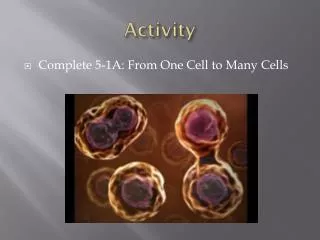
Activity • Complete 5-1A: From One Cell to Many Cells
Cell Cycle • Divided into three stages • Interphase • Mitosis • Cytokinesis
Interphase • Longest stage of the cell cycle • Carries out its functions • Example: stomach cells are making enzymes needed to digest food • 3 phases • G1 -Growth and Preparation • S- Replication • G2-Continued Growth and Preparation
Interphase • G1 – Growth and Preparation • Cell increases in size • Makes the proteins and molecules needed for the cell to function
Interphase • S- Replication • DNA copies itself • Cell temporarily has two sets of DNA • To replicate itself the DNA molecule unwinds and the steps of the ladder break apart.
Interphase • G2-Continued Growth and Preparation • Cell continues to grow and prepare for mitosis. • DNA is in a loosely coiled form • Organelles such as mitochondria and chloroplasts will be duplicated
Mitosis • Second Stage of the cell cycle • Usually the shortest stage • Process when the contents of a cell’s nucleus divide. • Division results in two daughter cells identical to the parent cell.
Mitosis • Early Prophase • Chromosomes pair up into X shaped structures. Protein fibers known as spindle fibers begin to form.
Mitosis • Late Prophase • Protein fibers complete forming • Attach to the chromosomes at a point called the centromere • Nuclear membrane breaks down
Mitosis • Metaphase • Chromosomes are pulled to the middle (equator) of the cell.
Mitosis • Anaphase • Protein fibers contract and pull the chromatids to opposite poles of the cell.
Mitosis • Telophase • One complete set of chromosomes is now at each pole of the cell • Nuclear membrane forms around each set of chromosomes. • Now there are two nuclei in one cell
Cytokinesis • Final stage of the cell cycle • Cell membrane pinches together to divide the cell’s cytoplasm and organelles.
Checkpoints • Checkpoints in the cell cycle monitor cell activities and instructs the cell whether or not to divide. • Cells will not divide if: • There are not enough nutrients to support cell growth. • DNA within the nucleus has not been replicated • DNA is damaged.
Cell Cycle and Cancer • If a mutation occurs in a gene producing the instructions for a checkpoint protein, cell cycle control will be lost. • A damaged cell may divide uncontrollably which is called cancer. • Cancer cells also have large, abnormal nuclei
Check Your Understanding • Complete questions p. 151 #1, 2, 4, 6, 8, 9, 11
Asexual Reproduction • Only one parent is required to produce offspring. • Offspring look identical to the parent • Can you name some organisms which reproduce through asexual reproduction? • Bread Mould • Trees • Potatoes • Tulip bulbs
Types of Asexual Reproduction • Binary Fission • A single parent cell reproduces itself and divides into two equal parts • Example: Amoeba and Bacteria E Coli Bacteria
Types of Asexual Reproduction • Budding • Occurs when part of the cell pushes outward to form a growth or bud. • Pinches off from the parent cell to form a new organism identical to the parent. • Example: yeast, hydra, sponges
Types of Asexual Reproduction • Fragmentation • Some animals can reproduce asexually from fragments • Example: Starfish, Japanese Knotweed
Types of Asexual Reproduction • Vegetative Reproduction • Occurs when special cells, usually in the stems and roots divide repeatedly to form structures that will develop into a new plant.
Types of Asexual Reproduction • Spore Formation • A spore is a reproductive cell that grows into a new individual by mitosis. Ex: Bread Mould • Spores are lightweight and rely on wind and water to carry the spores away from the parent. • Why is it important to carry the spores away from the parent?
Asexual Reproduction p. 161
Checkpoint • Complete questions • p. 165 • # 1, 3, 4, 7, 9, 11, 13 • P. 166-167 • #3, 4, 5, 6, 10, 15, 16, 17,19,