Understanding Syntax and Semantics in Programming
380 likes | 472 Views
Learn the rules of writing valid identifiers, variable declarations, assignment statements, and output in programming languages. Understand the importance of meaningful identifier names and how to manipulate data.


Understanding Syntax and Semantics in Programming
E N D
Presentation Transcript
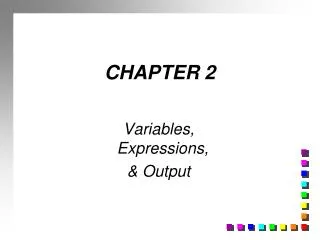
CHAPTER 2 Variables, Expressions, & Output
Syntax vs. Semantics • Syntax • language rules • how valid instructions are written in a programming language • GRAMMAR English
Semantics • rules determining MEANING • of instructions in programming language
What is an identifier? • A name associated with a process or object used to refer to that process or object • John, Sue, Larry • mass, volume, pay
What are rules for valid identifiers? • Identifiers are made of • letters • digits • underscore • The first character must be a • letter • underscore
VALID IDENTIFIERS • sum_of_squares J9 GetData • box_22A count Bin3D4 • INVALID • 40Hours Get Data Box-22 • stock_# if return • RESERVED WORDS • word that has special meaning in cannot be used as identifier (if)
Why is it important to use meaningful identifier names? • Easier to understand • Self documenting • Compare printtopportion PRINTTOPPORTION PrintTopPortion • Last is best
Case Sensitive • Identifiers with different capitalization are entirely distinct. • Total total • Two different identifiers.
What is a declaration? • Associating identifier (name) with • data object • function • So programmer • can refer to that item • by name (naming object)
What is a variable? • A location in memory • referenced by an identifier • in which a data value is stored • value can change
Example Declarations • var Identifier [, Identifier, …]; • var empNum; • var studentCount, maxScore, sumOfScores; • or better • var studentCount; // Description • var maxScore; // Description 2 • var sumOfScores; // etc. • best, declare when needed
What Does a Variable Declaration Do? var ageOfDog; var taxRateY2K; var middleInitial; • Tells the compiler to • allocate enough memoryto hold value of this type • associate the identifierwith this location. 4 bytes for taxRateY2K 1 byte for middleInitial
When to Declare? • Declare vars when needed • NOT at top of the main block
What is an assignment statement? • A statement • gives the value of an expression • to a variable.
Valid Assignment Statements • Variable = Expression; • var num; var alpha; • var rate; var ch; • alpha = 2856; • rate = 0.36; • ch = 'B'; • num = alpha;
Valid Expressions • constant variable • constant and/or variables combined with operators • Examples • alpha + 2 rate - 6.0 • 4 - alpha rate • alpha * num 12
Unary and Binary Operators • Unary Operator • an operator that has just one operand • + - • Binary Operator • an operator that has two operands • + - * / %
Modulo Arithmetic (%) • % operator • yields remainder of integer division • Use with integers only • 5 % 3 = 2 • 9 % 4 = 1 • 8 % 2 = 0 • 3 % 5 = 3
3 + 6 = ? 9 3.4 - 6.1 = ? -2.7 2 * 3 = ? 6 8 / 2 = ? 4 8.0 / 2.0 = ? 4.0 8 / 8 = ? 1
8 / 9 = ? 0 8 / 7 = ? 1 8 % 8 = ? 0 8 % 9 = ? 8 8 % 7 = ? 1 0 % 7 = ? 0
Valid Assignment Statements • Variable = Expression; • var num = i; var alpha = j; • alpha = num + 6; • alpha = num / 2; • num = alpha * 2; • num = 6 % alpha;
What is a literal value? • Any constant value written in a program. • Integers, real numbers, characters, strings of characters: • 34 921.2196 • 'D' "Hi There"
How do you output data? • println("Hello"); • println (Processing, not JS) • Writes to the text area of the Processing environment's console. • Each call to this function creates a new line of output. • Individual elements can be separated with quotes ("") and joined with the string concatenation operator (+).
Items are separated by + • literals are in quotes, • variable names or expressions allowed. • println(ExprOrString + ExprOrString);
Examples: • var x; var y; var z; • x = 1; y = 2.3; z = 'A'; • println("x =" + x); • println("y =" + y + "z =" + z); • println("***"); • Output: x =1 y =2.3z =A *** • Insert white spaces in the output where needed!
var x = -12345; • var y = 1.23456789; • var z = 'B'; • println(x + " " + y + " " + z); Output: -12345 1.23457 B
The assignment statement is not an equality. • Var = Expr; • The assignment statement • takes the value of the expression • and assigns it to the variable. • It does NOT determine if the values are equal.
Assignment Statement not equality • alpha = alpha + 1; • --Legal assignment, not equality • num = num + alpha;
Increment and Decrement • ++ -- • num++; • ++num; ===> num = num + 1; • num--; • --num; ===> num = num - 1; • Use as standalone statements.
String Literals • a string is a sequence of characters enclosed in double quotes • string literal sample values "Hello" "Year 2000" "1234" • the empty string (null string) contains no characters and is written as ""
String Concatenation (+) • concatenation is a binary operation that uses the + operator • at least one of the operands must be a string variable or named constant--the other operand can be string type or var type
Concatenation Example var WHEN = "Tomorrow" ; var EXCLAMATION = '!' ; var message1 ; var message2 ; message1 = "Yesterday " ; message2 = "and " ; message1 = message1 + message2 + WHEN + EXCLAMATION ; println(message1);
How does one add comments to a program? • Comments giving explanatory notes • They may appear anywhere in a program. • /* */ around text. • // Comment the rest of a line • It is good programming style to add descriptive comments to your program. • Paste document.cpp to top of program