Download
1 / 1
10 likes | 154 Views
This document outlines essential guidelines for the naming and decomposition of Organizational Elements (OEs) within the Department of Defense. It emphasizes the importance of unique, easily readable names that avoid codes or abbreviations and follow a consistent formatting style. Notably, it posits that names should refer explicitly to the OE in question without mentioning ancestors or descendants unless historically supported. The document also stresses the importance of correct decomposition, ensuring that each unit has a clearly identified headquarters and aligns with standard military organizational structures.

E N D
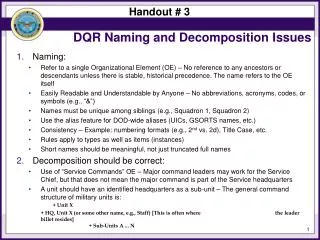
DQR Naming and Decomposition Issues Naming: Refer to a single Organizational Element (OE) – No reference to any ancestors or descendants unless there is stable, historical precedence. The name refers to the OE itself Easily Readable and Understandable by Anyone – No abbreviations, acronyms, codes, or symbols (e.g., “&”) Names must be unique among siblings (e.g., Squadron 1, Squadron 2) Use the alias feature for DOD-wide aliases (UICs, GSORTS names, etc.) Consistency – Example: numbering formats (e.g., 2nd vs. 2d), Title Case, etc. Rules apply to types as well as items (instances) Short names should be meaningful, not just truncated full names Decomposition should be correct: Use of “Service Commands” OE – Major command leaders may work for the Service Chief, but that does not mean the major command is part of the Service headquarters A unit should have an identified headquarters as a sub-unit – The general command structure of military units is:+ Unit X + HQ, Unit X (or some other name, e.g., Staff) [This is often where the leader billet resides] + Sub-Units A ... N Handout # 3