The Cell Membrane
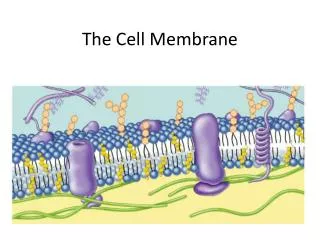
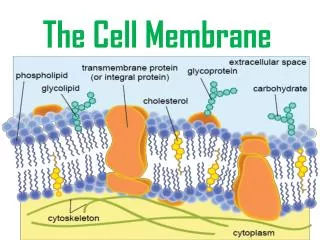
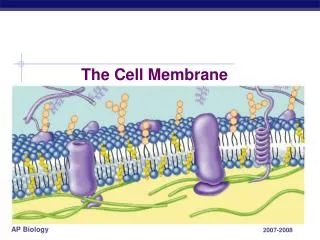
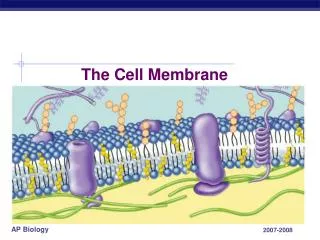
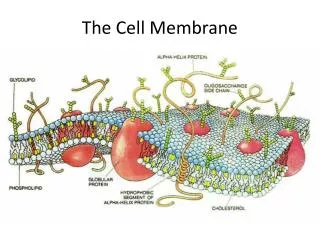
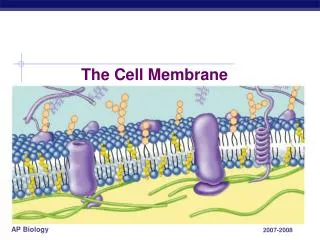
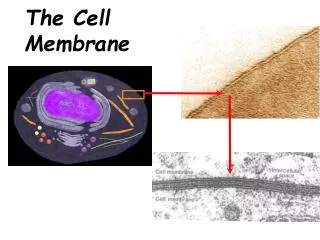
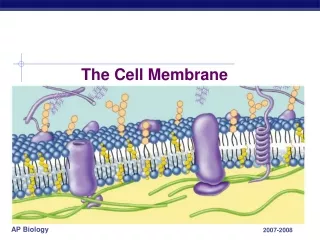
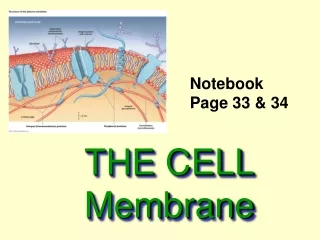
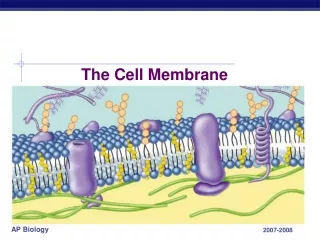
The cell membrane is primarily composed of phospholipids, which feature a hydrophilic phosphate group and two hydrophobic fatty acids, forming a lipid bilayer. This structure is crucial for passive transport mechanisms, which allow substances to cross the membrane without energy expenditure. Examples include diffusion, where substances move from areas of high to low concentration, and osmosis, the diffusion of water across a semi-permeable membrane. Water movement can be categorized into hypertonic, hypotonic, and isotonic solutions.

The Cell Membrane
E N D
Presentation Transcript
The Cell Membrane Pages 60-61
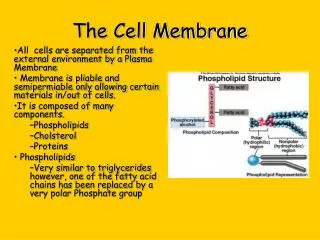
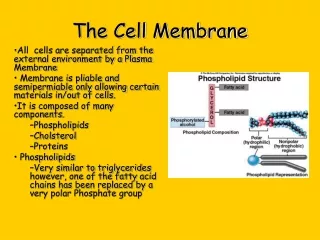
Vocabulary • Phospholipid = lipid made of a phosphate group and two fatty acids
Vocabulary • Polar = Hydrophilic, or "water-loving” • Soluble in water • Nonpolar = Hydrophobic, or “water-fearing” • NOT soluble in water
Vocabulary • Lipid bilayer = the basic structure of a membrane, composed of two layers of phospholipids
Passive Transport • Passive transport = movement across the cell membrane that DOES NOT require energy • Examples = Diffusion and Osmosis
Passive Transport - Diffusion • Diffusion = the movement of a substance from an area of HIGH concentration to LOW concentration. • Note: the symbol for concentration is [ ].
Passive Transport - Diffusion • Equilibrium = [ ] of a substance is EQUAL throughout a space
Passive Transport - Osmosis • Osmosis = the diffusion of water across a semi-permeable membrane
Passive Transport - Osmosis • 3 possibilities for direction of H2O movement: • Hypertonic solution = water moves OUT • High [solute] in solution • Hypotonic solution = water moves IN • Low [solute] in solution • Isotonic solution = NO NET WATER MOVEMENT • Equal [solute] as [H2O]