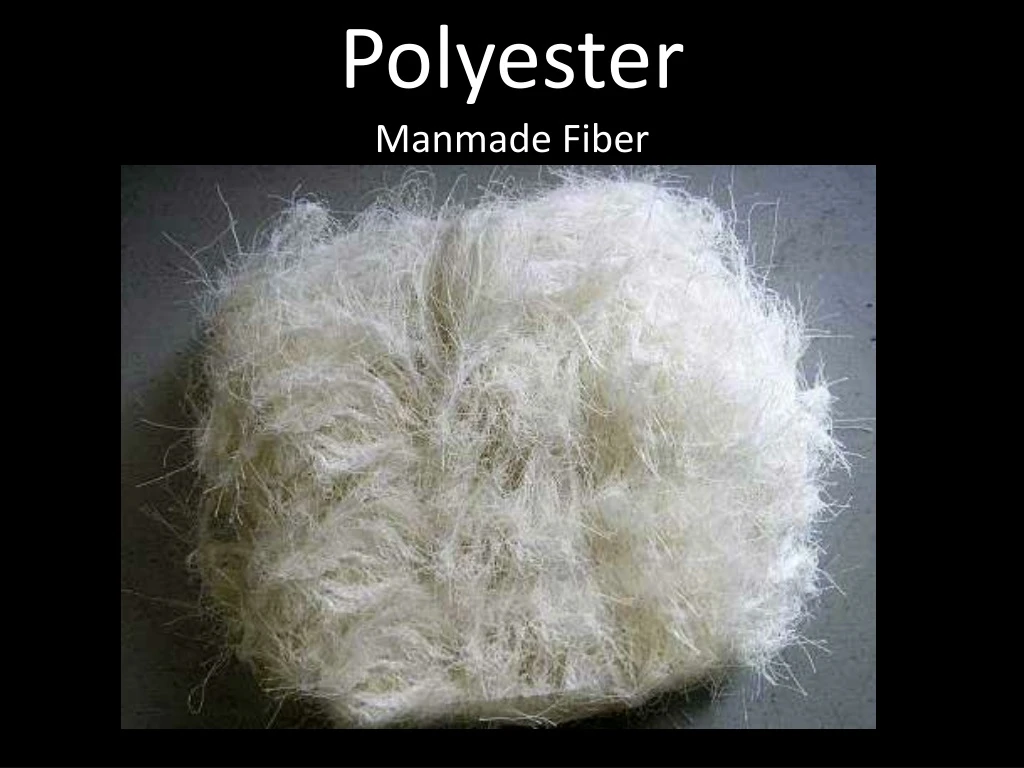
Polyester Manmade Fiber
170 likes | 213 Views
Explore the intriguing history of polyester fiber from its discovery to modern use. Learn about the advantages, disadvantages, and proper care tips for this versatile manmade material.


Polyester Manmade Fiber
E N D
Presentation Transcript
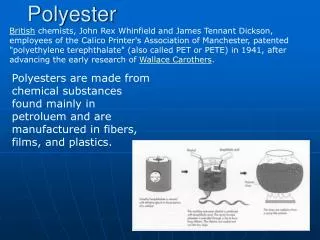
History… • Polyester began as a group of polymers in W.H. Carothers’ laboratory • Carothers was working for duPont at the time when he discovered that alcohols and carboxyl acids could be successfully combined to form fibers • Polyester was put on the back burner, however, once Carothers discovered nylon • A group of British scientists– J.R. Whinfield, J.T. Dickson, W.K. Birtwhistle, and C.G. Ritchie– took up Carothers’ work in 1939 • In 1941 they created the first polyester fabric called Terylene • In 1946 duPont bought all legal rights from the Brits and came up with another polyester fiber which they named Dacron
Polyester was first introduced to the American public in 1951 • It was advertised as a miracle fiber that could be worn for 68 days straight without ironing and still look presentable • In 1958 another polyester fiber called Kodel was developed by Eastman Chemical Products, Inc. • The polyester market kept expanding since it was such was such an inexpensive and durable fiber • Polyester experienced a constant growth until the 1970s when sales drastically declined due to the negative public image that emerged in the late 60s as a result of the infamous polyester double-knit fabric
Advantages • Easily dyed • Strong • Light weight • Resistant to: • Shrinking • Stretching • Mildew • Creasing • Fading from the sun • Easy to care for • Offered in many forms- knits, jerseys or cottons, and silk-like fabrics
Disadvantages • No breathe • Fabric shine can be unattractive • Stains are difficult to remove • Retains body heat and moisture like sweat • Not as comfortable as some of the natural fibers • Can cause rashes and skin irritation on those with sensitive skin • Not environmentally friendly
Care • Use warm water on normal cycle in washing machine • Add fabric softener before the final rinse cycle- polyester is sensitive to static electricity and fabric softner will help prevent that • Machine dry at a low/lowest temperature setting for about 10 minutes to remove wrinkles- polyester does shrink, so avoid heat as much as possible • Hang or lay the garment out for the completion of the drying time- if the garment becomes to dry in the dryer it may shrink so it is better to air dry • If ironing is needed, use a moderately warm iron- if the iron is too hot it will burn the polyester