Download
1 / 54
540 likes | 626 Views
Explore the dynamic period of Reconstruction (1865-1876) in American history, highlighting achievements, conflicts, and ongoing impact. Dive into the complexities of democracy, power dynamics, social class, and the role of race and ethnicity in shaping the nation. Uncover the tensions surrounding inclusion and exclusion, labor issues, and reform movements post-Civil War. Understand the significance of the era in shaping modern American society and its ongoing challenges.

E N D
Reconstruction, 1865-1876 Achievements, Conflicts, Failures, and Ongoing Impact
Interpretive Framework for the Course • America/U.S. – as an idea, a nation, a people – is a work in progress • It is a project • It has not developed in linear fashion • It has not always progressed towards ideals • Consistent conflict over the shape of the nation • Conflict over who should be included and excluded
Major Course Topics • Democracy • Power • Social Class • Race and Ethnicity • Inclusion and Exclusion • Labor Issues • Reform and Social Movements • Role of the State
Background to Reconstruction Slavery and the Origins of the Civil War
Civil War Review • Slave system was basis of southern society, economy, and culture • Reasons for Civil War • Growing divide between North and South, economically, culturally, and politically • “States Rights” – the right of white southern elite planters to own and control black slaves, often supported by poor whites
Slavery & the Civil War: Review of the Data • Analyze the statistics on slavery in the U.S. leading up to the Civil War • What conclusions can you make? • Questions? • What statistics are most useful in understanding the onset of the Civil War?
Conclusions about Slavery and the Civil War • Slavery was an economic system, social hierarchy, form of domination and control, supported and justified by a cultural framework • Slave system was major cause of Civil War • The ongoing impact of slavery and the fate of the freed slaves were the main issues during Reconstruction
Why Did Poor Southern Whites Fight in Civil War? • Many lower-class whites bought into southern hierarchy – household • Control of land, household, labor, and political rights Male Planter Elite /\ White Women & Children /\ White Laborers /\ Slaves & Free Blacks Poor White Landowner or Renter /\ Wife & Children /\ Slaves and Free Blacks
Why Did Northerners Fight? • Abolitionist minority – fund. opposed to slavery – slavery was an evil, a stain on the nation – represented belief in full INCLUSION of blacks into nation • Free Labor majority – opposed to expansion of slavery • Slavery hurts free labor • Free labor = economic and political independence • Free people would not allow themselves to be enslaved • Republican and “republican” • Pro-Union – unification of nation [under free labor ideals] • Belief a pivot point to judge whether people are worthy of citizenship or rights
Ways of Understanding Reconstruction • Divided country after Civil War • Different, often conflicting, goals & ideals – Different definitions of freedom and equality • Achievements • Tragedies • Conflicts • Unresolved Problems • Lasting impact on later U.S. history
Traditional Interpretations of Reconstruction • Emphasized presidential and Congressional conflicts • Emphasized personal conflicts among leaders • Emphasized white leaders’ ideas and actions • Problems with this model? – left out the people most affected by slavery, the transition to freedom, and life on the ground in the Reconstruction south
Slaves, Freedpersons, and Freedom • Emphasis on freedpersons and their attempts to realize American ideals • Slaves had already made great efforts to achieve freedom during slavery and Civil War • Resistance during enslavement • Emancipation Proc. (Jan. 1863) • Fought for Union • Fled to Union lines • Attempted to reunify with families
Definitions of Full Freedom: • Conflicts over the definition of freedom for newly-freed slaves • What would FULL FREEDOM look like? (documents & class opinions):
Major Questions of Reconstruction: • Would nation fulfill its ideals of freedom and equality? • Would ex-slaves be fully incorporated as citizens into the new nation? • Would whites accept their integration into society? • Would the revolutionary possibilities of the Civil War and Reconstruction be fully realized? • What shape would new nation and regions take after the war?
Different Definitions of Reconstruction • Documents readings:
The Cotton Pickers, 1876 Winslow Homer
Sunday Morning in Virginia, 1877 Winslow Homer
Shaw Memorial, 1900 Augustus Saint-Gaudens
Shaw Memorial, Soldier's Head, 1883-93, bronze. Augustus Saint-Gaudens Link to short video on Shaw Memorial
Radical Republican Attitudes(based on 4 images) Class reactions: Why did it matter what white northerners thought of southern blacks?:
Achievements of Reconstruction: An Opening • Freedpersons fought for and claimed freedom and rights • 13th, 14th, 15th amendments (ended slavery, citizenship, voting for all men) • Founded black schools and churches • Black political participation, leadership • Republican Party and Union Leagues • Got land in very small areas • Southern states readmitted to Union – reunification of country
Black Efforts to Achieve Full Freedom, Barrow Plantation, Georgia Evidence?
Occupation of the south: Divided into Military Districts Freedmen’s Bureau Northern white financial support No. white teachers
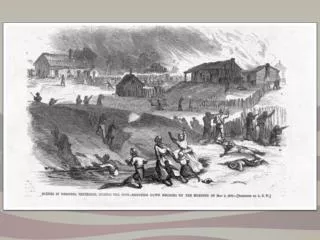
Southern White Tactics to Regain Power • Black Codes in early years of Reconst. • Ex. – can only marry within race • Ex. – forced former slaves to work • Ex. – control over work; imprisonment • Attempts to reinstitute slavery in fact, if not name • Organized violence: KKK and White Leagues • Organized political violence: Dem. Party used race-baiting and stereotypes to regain power – “Redemption” of the south
Southern White “Redemption” • Whites believed they had to “redeem” the south • Take it back from blacks, Republicans, and northerners • Used legal, political, and violent means • Political strategies • Racist images of black politicians • Used fear of blacks - threat to white womanhood • Intimidated and scared white Republicans • Fraud, voter intimidation • Very effective – “took back” all southern states
Process of Redemption: Dates in () = When white Democrats retook political control = Southern White Democratic Party, the Solid South
Labor in the South: Compromise • Sharecropping and debt peonage • Positive spin: a compromise between blacks and whites in south – neither got what wanted • Negative: blacks tied to land and poverty through debt • Negative: south tied to staple crop agriculture • Negative: regional econ. and political differences reinforced • Negative: southern white racism and discrimination not uprooted
Spread of Sharecropping by 1880: Percentage of farms sharecropped by county Most in areas of cotton and tobacco farming: Dark Green Areas
Effects of Sharecropping, Barrow Plantation, Georgia Positives and Negatives?
Failures of Reconstruction:The Closing • Continued political and regional divisions • Federal retreat from black rights • Southern white racism and denial of black rights • No women’s suffrage • Redemption – southern Dem. Party became white party linked w/ denial of black rights • No widespread land redistribution or change in southern economy to support black freedom
Causes of Failures • Most white Americans did not change their definitions of freedom, justice, or equality • They continued to define “America” in exclusive ways: people of certain races and women were not worthy of full citizenship rights • America as Inclusive or Exclusive? • Included former slaves if they met white goals and expectations • But whites fell back into stereotypes and power: freedpersons not worthy of inclusion or rights
Northern White Attitudes Expressed in this Graphic? Quote: “Is This a Republican Form of Government? Is This Protecting Life, Liberty, or Property? Is This the Equal Protection of the Laws?”
Columbia – “Shall I Trust These Men, And Not This Man?”
“This Is a White Man’s Government.”
Thomas Nast, “Colored Rule in a Reconstructed (?) State” Columbia: “You are aping the lowest whites. If you disgrace your race in this way you had better take Back Seats”
Thomas Nast, “The Ignorant Vote: Honors Are Easy”
The Veteran in a New Field, 1865 Winslow Homer (American, 1836–1910) Oil on canvas
Attitude Change & Political Compromise • Southern white opposition to black freedom and social change • Northern whites lost political willpower • Turned against freedpersons • Pres. Grant – corruption and lack of resolve • Northern Rep. redefined as northern party, focused on spoils of power from new urban/industrial economy • Compromise of 1876 – Hayes Pres., withdrawal of fed. troops from south to get Presidency • Panic of 1873 – economic problems; industrial labor question supplanted southern labor and civil rights
Conclusion: • Blacks fought for and won freedom • Positive legal and constitutional advances • Southern white violence and political opposition, and Northern white loss of willpower, combined to end high hopes of “new birth of freedom” for ex-slaves • Ideals of freedom, justice, and equality were sacrificed for political compromise between whites of both regions
Questions? • Who really won the Civil War? – militarily, economically, socially, culturally? • Can you make direct links between Reconstruction’s failures and later problems in U.S. history?
Opening Music • African American Work Song – “It’s a Long John” • “Trouble So Hard” • “It Makes a Long Time Man Feel Bad” • Prison and Blues – “Early in the Mornin’” • Deford Bailey, “John Henry” • Mississippi Fred McDowell, “John Henry” • Johnny Cash, Bruce Springsteen, Aaron Copland