Download
1 / 10
100 likes | 237 Views
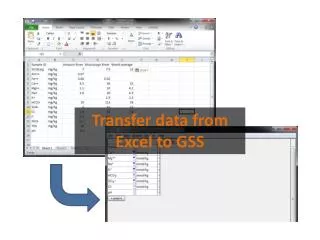
Easily move your geochemical data from Excel to GSS with this comprehensive guide. Begin by setting up your analytes in a new GSS spreadsheet. Add system parameters like temperature, pH, and date, or include basis species like Ca++ or Na+. Use the Add Analytes dialog to efficiently include multiple analytes from predefined lists or user-defined options. Adjust the order and units to align with your Excel data. Import your sample data by copying from Excel and pasting into GSS. Now you’re equipped to create plots, calculate mineral saturation, and perform data analysis!

E N D
Start by setting up your analytes in a new GSS spreadsheet You can addSystem parameters like temperature, pH, Eh, date, etc… …orBasis species representing chemical components like Ca++, Mg++, Na+, etc. … or choose User defined analytesto define and add custom analytes.
The Add Analytesdialog lets you add several analytes at once Choose from the System parameters, Basis species, or User defined analytes… + analyte→ Add Analytesto open the dialog … then select your analytes and click Apply
Rearrange the order of analytes to match your Excel spreadsheet Left-drag to reorder your analytes
Change the units to match your Excel spreadsheet Select analytes, right-clickon unit field, then choose Units → mg → mg/kg You can use elemental equivalent units. For mg/kg SO4−− as sulfur, right-click, then choose As → S.
You can transpose the data in your GSSspreadsheet if necessary Edit → Transpose Data Sheet
Add one or more columns for samples to GSS Click + sample
Copyyour numerical data and sample names from Excel… Highlight data then Ctrl + c to copy…
…then paste the values into GSS Ctrl + v pastes your data. Now you’re ready to work with your data. Try creating specialty plots, calculating mineral saturation, mixing samples, converting units, and more!










![Huawei File Transfer: How to Transfer Data from Huawei to PC [Solved]](https://cdn5.slideserve.com/9879676/how-to-transfer-data-from-huawei-to-pc-solved-dt.jpg)