Analyzing Working Independence in Longitudinal Data: OLS vs. MLE Estimates
This study explores the differences in estimating the slope in longitudinal data models under working independence versus modeling correlation. We generate data in clusters with five observations each, where the response follows a linear function of time. The analysis compares the variances of OLS slope estimates against those derived from MLE, focusing on the first-lag autocorrelation. While OLS assumes independent residuals, MLE captures autocorrelation, leading to more robust estimates. We discuss the benefits and drawbacks of using working independence models, emphasizing the importance of valid standard errors for reliable inferences.

Analyzing Working Independence in Longitudinal Data: OLS vs. MLE Estimates
E N D
Presentation Transcript
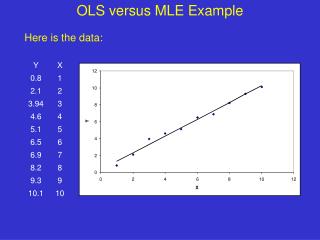
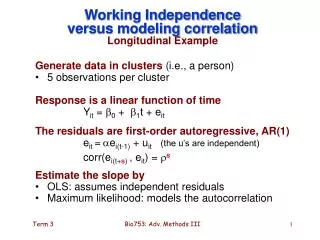
Working Independence versus modeling correlationLongitudinal Example Generate data in clusters (i.e., a person) • 5 observations per cluster Response is a linear function of time Yit = 0 + 1t + eit The residuals are first-order autoregressive, AR(1) eit =ei(t-1) + uit(the u’s are independent) corr(ei(t+s) , eit) = s Estimate the slope by • OLS: assumes independent residuals • Maximum likelihood: models the autocorrelation Bio753: Adv. Methods III
Comparisons Compare the following reported Var(1) • That reported by OLS (it’s incorrect) • That reported by a robustly estimated SE for the OLS slope (It’s correct for the OLS slope) • That reported by the MLE model • It’s correct if the MLE model is correct You can use any working correlation model, but need a robust SE to get valid inferences Bio753: Adv. Methods III
Variance of OLS & MLE Estimates of b versus , the first-lag Correlation MLE reported variance OLS reported variance True variance of OLS Bio753: Adv. Methods III
Benefits & Drawbacks of working non-independence Benefits • Efficient estimates • Valid standard errors and sampling distributions • Protection from some missing data processes • The MLM/RE approach allows estimating conditional-level parameters, estimating latent effects and improving estimates Drawbacks • Working non-independence imposes more strict validity requirements on the fixed effects model (the Xs) • Can get valid SEs via working independence with robust standard errors • At a sacrifice in efficiency Bio753: Adv. Methods III
There is no free lunch! Working independence models (coupled with robust SEs!!!) are sturdy, but inefficient Fancy models are potentially efficient, but can be fragile Bio753: Adv. Methods III