Download
1 / 4
40 likes | 186 Views
The scientific method is a structured process for investigating the universe. It starts with observation, leading to the construction of a hypothesis that aligns with what is observed. Predictions are made based on this hypothesis and are then tested through experiments. As new results emerge, the hypothesis may be revised. Facts are the outcomes of these observations, while hypotheses offer tentative explanations. Theories are broader frameworks that explain facts and predict new findings, characterized by generality, testability, and simplicity, following principles like Occam's Razor.

E N D
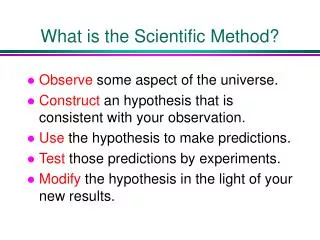
What is the Scientific Method? • Observe some aspect of the universe. • Construct an hypothesis that is consistent with your observation. • Use the hypothesis to make predictions. • Test those predictions by experiments. • Modify the hypothesis in the light of your new results.
Fact, Hypothesis, and Theory. • Fact: the result of an experimental observation. • Hypothesis: a tentative explanation of a fact or set of facts that has not yet been extensively tested. • Theory: a conceptual framework that explains existing facts and predicts the results of new observations.
Characteristics of a Theory. • Generality: the ideal theory should explain as many facts as possible (but not more than possible). • Testability: a theory should predict new facts that can be tested or observations that can be made (“falsifiability”). • “Beauty”: in general, the simplest theory that adequately explains a set of facts will be preferred (Occam’s Razor).
Range of a Theory. • A theory (or hypothesis) may serve as a fact that is explained by a more general theory. • The motions of the planets as explained by Kepler’s Laws. • Kepler’s Laws predicted by Newton’s Theory of Gravitation. • Newtonian Gravity as an approximation to General Relativity in the case of weak gravitational fields. • A theory with a limited range of applicability is at times called a model.