Effects of Depleted Uranium on Learning and Extinction in Sprague-Dawley Rats
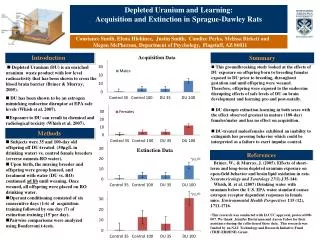
This study examines the impact of Depleted Uranium (DU) exposure on learning and extinction behaviors in Sprague-Dawley rats. Offspring born to DU-exposed mothers were monitored for changes in brain development and behavior. Results indicate that DU disrupts extinction learning, particularly in mature rats, but does not affect acquisition. This inability to extinguish conditioned behaviors may reflect impulse control issues, highlighting the potential risks of DU as an endocrine disruptor. The research emphasizes the need to understand DU's long-term behavioral effects in offspring.

Effects of Depleted Uranium on Learning and Extinction in Sprague-Dawley Rats
E N D
Presentation Transcript
Introduction Methods Depleted Uranium and Learning: Acquisition and Extinction in Sprague-Dawley Rats Constance Smith, Elena Hlohinec, Justin Smith, Candice Perks, Melissa Birkett and Megan McPherson, Department of Psychology, Flagstaff, AZ 86011 Acquisition Data Summary Depleted Uranium (DU) is an enriched uranium waste product with low level radioactivity that has been shown to cross the blood brain barrier (Briner& Murray, 2005). DU has been shown to be an estrogen mimicking endocrine disruptor at EPA safe levels (Whish et al. 2007). Exposure to DU can result in chemical and radiological toxicity (Whish et al. 2007). • This groundbreaking study looked at the effects of DU exposure on offspring born to breeding females exposed to DU prior to breeding, throughout gestation and until offspring were weaned. Therefore, offspring were exposed to the endocrine disrupting effects of safe levels of DU on brain development and learning pre-and post-natally. • DU disrupts extinction learning in both sexes with the effect observed greatest in mature (100-day) females/males and has no effect on acquisition. • DU-treated males/females exhibited an inability to extinguish bar pressing behavior which could be interpreted as a failure to exert impulse control. Subjects were35 and 100-day old offspring off DU-treated (30µg/L in drinking water) vs. control female breeders (reverse osmosis-RO water). Upon birth, the nursing breeder and offspring were group housed, and treatment with water (DU vs. RO) continued ad lib until weaning. Once weaned, all offspring were placed on RO drinking water. Operant conditioning consisted of six consecutive days (1-6) of acquisition training followed by one day (7) of extinction training (15’per day). Pairwise comparisons were analyzed using Bonferroni t-tests. References *p<.01 Briner, W., & Murray, J. (2005). Effects of short-term and long-term depleted uranium exposure on open-field behavior and brain lipid oxidation in rats. Neurotoxicology and Teratology27(1),135-144. Whish, R. et al. (2007) Drinking water with uranium below the U.S. EPA water standard causes estrogen receptor dependent responses in female mice. Environmental Health Perspectives 115 (12), 1711-1716. *p<.01 • This research was conducted with IACUC approval, protocol #08-007. We thank Jennifer Hesterman and Aaron Tabor for their assistance during the collection of these data. This research was funded by an NAU Technology and Research Initiative Fund (TRIF-ERDENE) Grant.