Download
1 / 20
200 likes | 330 Views
This review explores the dynamics of monsoons and extratropical climates, highlighting significant features such as sea surface temperature (SST) anomalies during El Niño and La Niña phenomena, the Walker circulation, and their global impacts. We examine seasonal temperature distributions and variations in rainfall associated with monsoon systems, along with the role of land-sea contrasts. Moreover, we delve into the effects of polar oscillations and the interaction of tropical and extratropical climates, enhancing our understanding of global weather patterns.

E N D
Review of last lecture • Mean state: The two basic regions of SST? Which region has stronger rainfall? What is the Walker circulation? • El Nino and La Nina: Which region has warm SST anomaly during El Nino? 4-year period. • Global impacts of ENSO • Effects of El Nino on U.S. winter temperature and precipitation: Warm temperature around Great Lakes, Heavy rainfall in California and Gulf coast
Land-sea Contrast: Seasonal “Monsoon” Seasonal temperature distributions: • T decreases poleward • Isotherms shift seasonally • T over land > water in summer
Temperature Ranges (Summer minus Winter) Large over land, small over ocean
The Seasonal “Monsoon” • A seasonal reversal of wind due to seasonal thermal differences between landmasses and large water bodies • is characterized by dry, offshore flow conditions during cool months and wet, onshore flow conditions during warm months. • Orographic lifting often enhances precipitation totals
World’s major monsoon systems From Jay Fein 1987
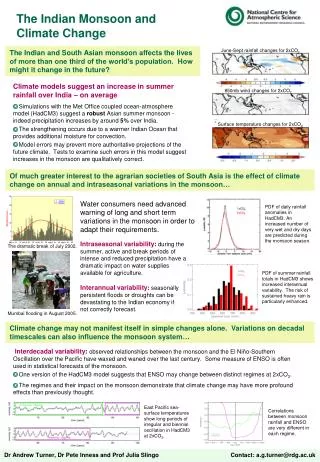
Impacts of monsoons:(1) Normal year Dry season Wet season
Impacts of monsoons:(2) Failure of monsoon and droughts Drought affected area in Karnataka, India, 2012, image from Wikipedia
Impacts of monsoons:(3) Excessive monsoon and floods Image from Doctors without Borders
Video: Pakistan flood in 2010 http://www.youtube.com/watch?v=beCVQqqTlKQ
Mean State • Westerly winds and jet streams • A constant Polar Vortex: transport/mixing, important for ozone hole
The Pacific/North American Oscillation (PNA): The way El Nino/La Nina affect U.S.
The Strengthening/Weakening of Polar Vortex • North Pole: Arctic Oscillation (AO) North Atlantic Oscillation (NAO) • South Pole: Antarctic Oscillation (AAO)
The Arctic Oscillation • Positive phase: Stronger polar vortex, colder temperature over Greenland, warm winter in U.S. • Negative phase: Weaker polar vortex, warmer temperature over Greenland, cold winter in U.S.
The Arctic Oscillation (AO) index • The AO does not have a preferred oscillation period, making it difficult to predict
Tropical-extratropical Interaction • Zonal mean (3 cells) • ENSO • The interactions are mutual
Summary Tropical climate: • Land-sea contrasts: seasonal monsoon Extratropical climate: • Mean state: westerly winds, polar vortex • What is the primary way El Nino affect extratropics? (PNA) • The oscillations associated with strengthening/weakening of polar vortex: AO, NAO, AAO