Maximize Project Success with Earned Value Management (EVMS) System
Learn about Project and Program Management, EVMS implementation, EVMS benefits, EV calculation methods, and project forecasting. Master key terms, planning steps, tracking, analysis, and corrective actions with EVMS.

Maximize Project Success with Earned Value Management (EVMS) System
E N D
Presentation Transcript
Using Earned Value Management System (EVMS) Briefing for ATC Engineering & Test Division (ACT-200) Managers and Leads
Briefing Objectives • What is a Project? • What is a Program? • What is Project Management? • What is EVMS? • Why do we need EVMS? • How is EVMS Implemented? • Who will implement it?
Project Management Terms - IV • Project - • A temporary endeavor • To create a unique product or service. • Program - • A group of related projects - e.g. DSR, VSCS, URET, STARS, ...as part of NAS • Managed in a coordinated way - ACT-200 Coordinating • Usually include elements of ongoing operations Complements of Project Management Institute
Project Management Terms - I • PM is the Application of Knowledge, Skills, Tools, and Techniques to Project Activities to Meet or Exceed Stakeholders’ Needs & Expectations. • Knowledge of general management practice & relevant application areas. • PM overlaps general management in many areas but they are not synonymous - e.g DSR vs. Division/Branch.
Project Management Terms - II • Work Breakdown Structure (WBS): A deliverable-oriented grouping of project elements which organizes and defines the total scope of the project. Each descending level represents an increasingly detailed definition of a project component. Project components may be products or services.
Project Management Terms - III • Work Package: Lowest Level of the WBS that may be Divided into Activities. • OBS: An Organizational Chart Relating Work Packages to Organization Units. • Responsibility Matrix: Relates Organization Structure to WBS & Ensures that each Element of the Project’s Scope of is Assigned to a Responsible Individual.
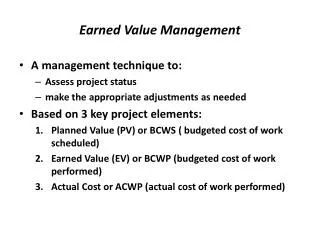
Earned Value Management System (EVMS) - I • EV - Tool for Measuring Project Performance • Compares work actually accomplished to work planned to determine if cost & schedule performance is as planned • EV is an Early Warning System • Helps management make proactive decisions to keep projects on course
Earned Value Management System (EVMS) - II • EV Integrates Cost, Scope & Schedule measurements • EV Involves Calculating 3 key values for each activity • Budget - BCWS • Actual Cost - ACWP • Earned Value/Physical Progress - BCWP • Basis for variance analysis
Planning for EVMS - I • Create a work breakdown structure • Organize work into discrete work packages and activities • Allocate a budget to each of the activities • Develop a schedule and Assign resources to accomplish each activity on the schedule • Be sure to include all work in the schedule
Planning for EVMS - II • Award performance credit for physical % complete using any of these methods • 0-100 • Short duration tasks < 160 hours • EV is Zero until activity is complete • 50-100 • Duration less than 600 hours • 50% at start of activity & 50% at completion
Planning for EVMS - III • Interim milestone; • Duration less than 600 hours • Based on completed milestone for task • Level of Effort (LOE) • Long duration & consistent tasks • Difficult to measure - no deliverables • Measured by duration of time used e.g. 10 weeks support is 50% complete at 5 weeks
Tracking & Analysis • Each update cycle/Reporting Period • Monthly or Bi-Monthly • Obtain physical % complete for each task • Calculate EV for each task • Sum up EV for all tasks as project EV • Calculate actual expenditure for actual work completed during the period • Compare the Cumulative EV to Actual expenditure
Elements of EV Analysis - I • Performance indices relate value of work performed to dollar spent. e.g. CPI = 0.65 means that for every dollar spent, actual value of the work performed is $0.65. • Cumulative CPI used to forecast project cost at completion (also slide 17) • Cumulative SPI used to forecast project completion date (also slide 17)
Elements of EV Analysis - II • Cost Variance - Difference between budgeted cost of work scheduled & actual cost of work performed • CV = BCWP - ACWP • Schedule Variance - Difference between budgeted cost of work scheduled & actual cost of work performed • SV = BCWP - BCWS
Elements of EV Analysis - II • SPI - BCWP/BCWS • SPI => 1.0, Project Schedule performing as planned or better • SPI < 1.0, Project not performing as planned - needs help
Elements of EV Analysis - III • CPI - BCWP/ACWP • CPI => 1.0, Project Cost performing as planned or better • CPI < 1.0, Project Cost not performing as planned - needs help • % Over/Under Budget - CAC - BCWS
Project Cost & Schedule Forecast Methods • Estimate at Completion (EAC) is total cost to complete an activity, work package, or a project expressed as:: • EAC = Actuals-to-date + Estimate to complete (ETC) • Cost EAC - BAC/CPI • Schedule EAC - BAC/SPI
EV Reporting • Interpret the results of the calculations - Slides 8 - 11 • Take or recommend corrective action as necessary
Conclusion • EVMS provides management with an effective • tool for program planning and control • early warning system for program mgt. • EV Integrates Cost, Quality, & Schedule objectives when appropriately implemented • Must a baseline for measurements, and control at the start of project.
References • Project Management Institute (PMI), 1996. A Guide to the Project Management Body of Knowledge (the PMBOKTM Guide) - • Ray W. Stratton, 1999. Improving SPI and CPI Calculations on LOE Heavy Programs, Proceedings of the 30th Annual PMI Seminars & Symposium • Fleming and Koppeman, 1996. Earned Value Project Management.
Thank you for Listening Pat A. Eigbe, PMP®, -- Hi-Tec Systems x. 5-7857