Download
1 / 8
80 likes | 200 Views
The panel discussion held in Leiden on January 19, 2012, led by Chair D.C. Dragos, explored various allocation systems and their transparency. Key topics included the types of rights to be allocated, scarcity versus public policy, and the necessity of transparent procedures. Discussions also touched on the design and criteria of allocation systems, institutional arrangements, and the balance between governmental and professional bodies. The session emphasized the importance of ex-ante and ex-post transparency, the role of communication, and redress mechanisms in enhancing accountability and fairness within these systems.

E N D
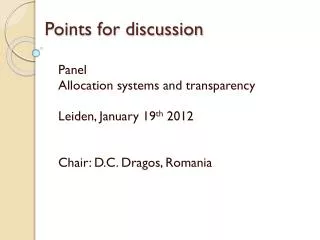
Points for discussion Panel Allocation systems and transparency Leiden, January 19th 2012 Chair: D.C. Dragos, Romania
ALLOCATION SYSTEMS • TYPE OF RIGHTS TO BE ALLOCATED • Scarcity vs. Public policy Natural / technical Public interest
Procedure • Order of application : 1st came, 1st served • Drawing of lots: similar offers • Bid (auction) : highest offer • Tender: combination of criteria • Gambling: monopolies / restrictions • Radio: EU harmonization • CO2: trading schemes
What scope for transparency? • Institutional arrangements • Governmental bodies vs. professional bodies • Independence? • Freedom of choice regarding public policy • Choice of the allocation system • Design of the allocation system
What scope for transparency? • Allocation procedure • Establishing criteria • Usage of the scarce right • Limitation of possible applicants: new entrants (competition) vs. past experience
1. Ex ante transparency • Drafting the rules – legal certainty • Availability of the right • Design of the allocation system • Publicity
2. Transparency of the procedure • Competent body • Timeframes – reasonableness • Communication with interested parties – publicity • Redress procedures • access to documents • Legal consequences for lack of transparency
3. Ex post transparency • Control mechanisms • Transparency of findings • Sanctions and their publicity • Consequences for infringement of transparency requirements • Redress • Transparency of requirements for renewal • Conditioned by performance – assessment? • Regardless of performance – new entries, competition?