Download
1 / 22
220 likes | 339 Views
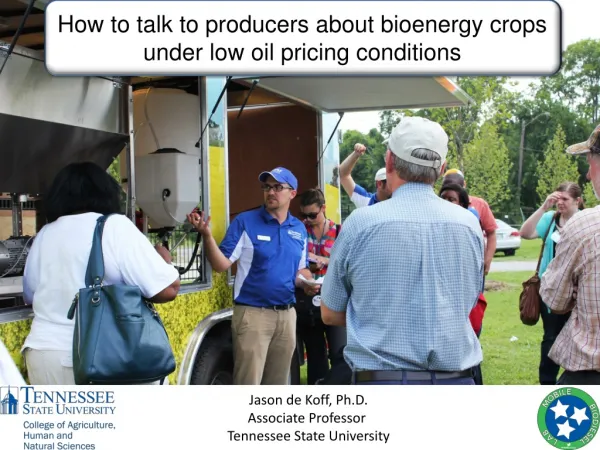
In this presentation, Dr. Jason de Koff from Tennessee State University discusses how to engage producers about bioenergy crops in the current low oil pricing environment. With a focus on on-farm fuel production costs and a retrospective assessment of perceptions towards biodiesel, Dr. de Koff explores viable alternatives including switchgrass and canola meal for animal feed. Insights into the Environmental Quality Incentives Program and strategies for wildlife habitat improvement are also covered, highlighting economic considerations for sustainable farming practices.

E N D
How to talk to producers about bioenergy crops under low oil pricing conditions Jason de Koff, Ph.D. Associate Professor Tennessee State University
Evaluation • Retrospective/Post questionnaire • Assessed changes in perceptions, awareness, interest and knowledge of biodiesel production
Other alternatives May 22nd
Protein content of meal Canola meal animal feed
Switchgrass $70.5 million – State of Tennessee $85 million – DuPont
Native warm-season grasses Switchgrass
Other alternatives • Tall mix for Deer/Turkey • 1.5 lbs PLS/acre Big bluestem • 1.0 lb PLS/acre Indiangrass • 1.5 lbs PLS/acre Little bluestem • Short mix for Quail/Rabbit • 3.0 lbs PLS/acre Big bluestem • 0.5 lb PLS/acre Indiangrass or Switchgrass • 1.0 lb PLS/acre SideoatsGrama
Forage Quality 4-5 tons/acre for hay 1.5-2.5 lbs daily gain Keyser et al., 2011
Program Assistance • Environmental Quality Incentives Program • Through NRCS • Pay a portion of the average cost associated with the developed conservation plans • Farm Wildlife Habitat Program • Through TWRA • Provides 75% reimbursement (up to $2,000 per contract per year) to improve wildlife habitat
Economic considerations for Pellet Stoves Wilson et al., 2012
Questions? Jason de Koff jdekoff@tnstate.edu 615-963-4929 Twitter: @TSUBioenergy