Download
1 / 7
70 likes | 190 Views
Double replacement reactions occur when the ions of two compounds exchange places in an aqueous solution to form new compounds, typically resulting in a precipitate or water. For example, the reaction between lead(II) nitrate and potassium iodide produces lead(II) iodide, a solid precipitate, and potassium nitrate. The complete ionic equation illustrates the ions involved, while the net ionic equation focuses on the key ions that form the precipitate. Understanding solubility rules is crucial for predicting outcomes in these reactions.

E N D
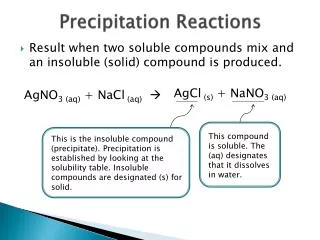
Double Replacement Reactions The ions of two compounds exchange places in an aqueous solution to form two new compounds. AX + BY AY + BX One of the compounds formed is usually a precipitate (an insoluble solid) or a molecular compound, usually water.
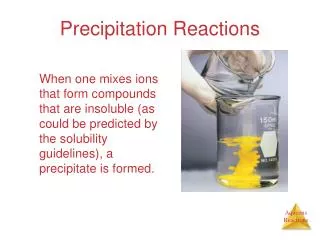
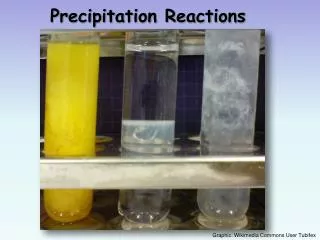
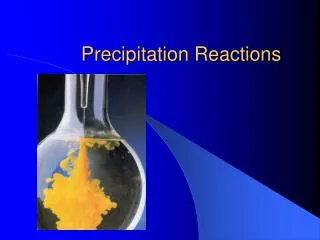
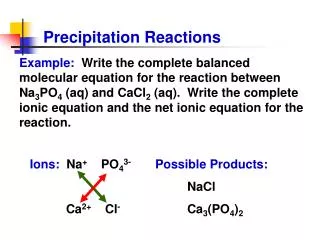
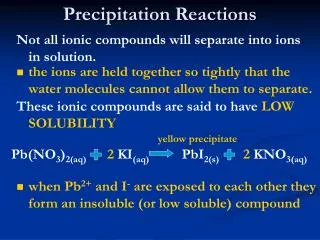
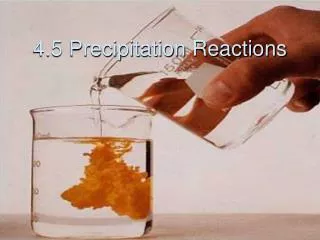
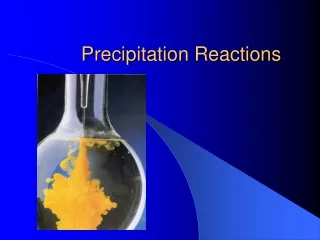
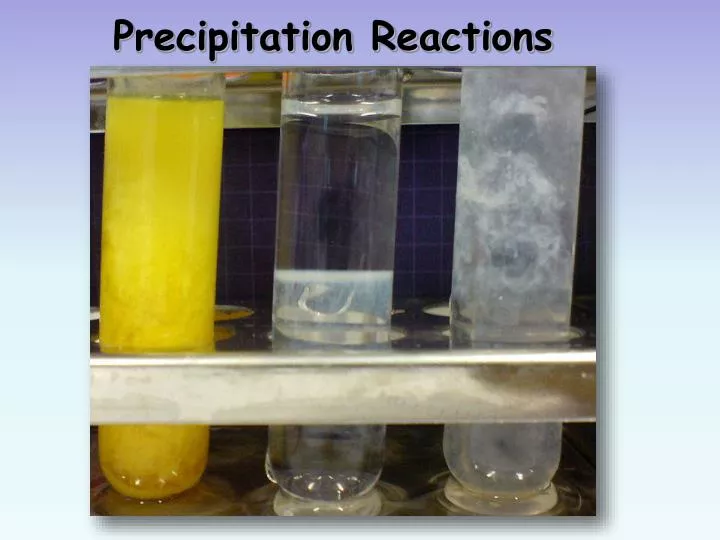
Double replacement forming a precipitate… Lead(II) nitrate + potassium iodide lead(II) iodide + potassium nitrate Double replacement (ionic) equation Pb(NO3)2(aq) + 2KI(aq) PbI2(s) + 2KNO3(aq) Complete ionic equation shows compounds as aqueous ions Pb2+(aq) + 2 NO3-(aq) + 2 K+(aq) +2 I-(aq) PbI2(s) + 2K+(aq) + 2 NO3-(aq) Net ionic equation eliminates the spectator ions Pb2+(aq) + 2 I-(aq) PbI2(s)
Solubility Rules for Chemistry All sodium, potassium, ammonium, and nitrate salts are soluble in water. Memorisationof other “solubility rules” is beyond the scope of this course, you will always be given a solubility table for your Chemistry test & exam.
Solubility Chart:Common saltsat 25C S = Soluble I = Insoluble P = Partially Soluble