Understanding Oscilloscopes: Functions, Types, and Probes Explained
An oscilloscope is a vital instrument for visualizing electrical signals in real-time. It plots voltage (Y-axis) over time (X-axis), and some models feature an intensity axis (Z-axis). Essential for analyzing frequency, phase, and signal components, oscilloscopes can be analyzed through DC and AC signals, rise and fall times, and mathematical functions. Key areas include the control panel settings, such as vertical and horizontal systems and triggers. Various probe types, including passive and active, enhance measurement capabilities for high-frequency and low-voltage signals. Explore the advantages of digital technology in modern oscilloscopes.

Understanding Oscilloscopes: Functions, Types, and Probes Explained
E N D
Presentation Transcript
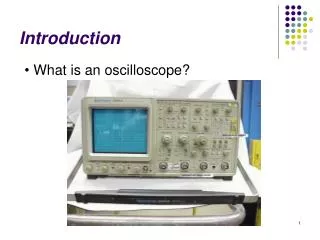
Introduction • What is an oscilloscope?
Introduction • A graph-displaying device of electrical signal • X axis: Time • Y axis: Voltage • Z axis: Intensity or brightness
Introduction • Information given by oscilloscopes • Time and voltage • Frequency and phase • DC and AC components • Spectral analysis • Rise and fall time • Mathematical analysis
Control panel of an oscilloscope • Vertical Section • Horizontal Section • Trigger Section
Basic setting • Vertical system • attenuation or amplification of signal (volts/div) • Horizontal system • The Time base (sec/div) • Trigger system • To stabilize a repeating signal and to trigger on a single event
Analog oscilloscope • Real-time display of signals • Block diagram • Sweep generator and vertical amplifier • Earthquake recorder
Digital oscilloscope • Capture and view events • Digital storage oscilloscope (DSO)
Digital oscilloscope (contd.) • Sampling • Interpolation
Advantage of Digital Scope • Trend towards digital. • Easy to use. • One-shot measurement • Recoding • Triggering • Data reuse • Connectivity
Probes • Components
Probes • High quality connector • High impedance (10M) • 50 for high frequency measurement
Passive probe • 10 attenuation • Good for low circuit loading • Suitable to high frequency signal • Difficult to measure less than 10mV signals • 1 attenuation • Good for small signals • Introducing more interference
Active probe • Signal conditioning ⇒ oscilloscope • Require power source • Good for high speed digital signals over 100MHz clock frequency