Regulation of SCF Complex and Neddylation Dynamics in Response to DNA Damage and Replication Stress
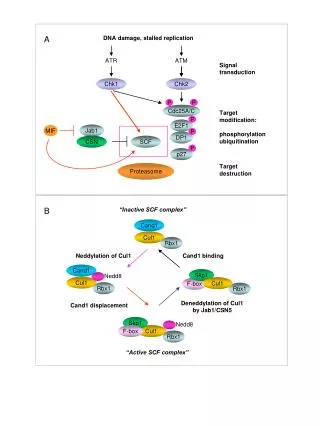
This article explores the intricate process of SCF complex regulation, focusing on its role in ubiquitination and phosphorylation in response to DNA damage and stalled replication. The dynamic interplay between Nedd8 modification, the recruitment of Cdc25A, and the action of the proteasome highlights the mechanisms of target degradation. We discuss the transition from an inactive to an active SCF complex through Neddylation and the importance of signaling pathways such as ATR and ATM, including their impact on Chk1 and Chk2 activation.

Regulation of SCF Complex and Neddylation Dynamics in Response to DNA Damage and Replication Stress
E N D
Presentation Transcript
Cand1 Cand1 Cul1 Cul1 Rbx1 Rbx1 Nedd8 Skp1 Nedd8 P P Jab1 MIF Cul1 Cdc25A/C Rbx1 CSN SCF P E2F1 P DP1 Proteasome P p27 A DNA damage, stalled replication ATR ATM Signal transduction Chk1 Chk2 Target modification: phosphorylation ubiquitination Target destruction B “Inactive SCF complex” Neddylation of Cul1 Cand1 binding Skp1 Cul1 F-box Rbx1 Deneddylation of Cul1 by Jab1/CSN5 Cand1 displacement F-box “Active SCF complex”