Sensation and Perception
This exploration of sensation and perception delves into how attention impacts our experience of reality. Concepts such as selective attention, figure-ground organization, and Gestalt principles illustrate how we focus on certain aspects while ignoring others. We examine depth perception, perceptual organization, and the influence of context on our perceptions. Additionally, we touch on perceptual illusions, including the Ponzo and Muller-Lyer illusions, and the concepts of extrsensory perception. Discover how our beliefs and predispositions shape our understanding of the world around us.

Sensation and Perception
E N D
Presentation Transcript
Focusing attention on one aspect of our experience E.g. Focusing on good looks and ignoring personality Selective attention
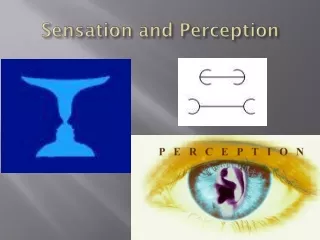
Figure = Foreground - what we focus on Ground = Background Figure & ground
Proximity Similarity Continuity Connectedness Closure Seeing complete letters on a sign even though some bulbs are burned out. Grouping
Visual cliff Infants will stop at the “cliff” The ability to perceive depth is at least partially innate. Depth perception
Gestalt psychologists The whole is more than the sum of its parts Perceptual organization
Linear perspective Parallel lines converge E.g. Railroad tracks
Phi phenomenon Apparent movement of stationary lights Las Vegas marquees Stroboscopic movement Cartoon book flip pages Motion perception
Ponzo Illusion A bar further away appears larger even if the same size on our retinas. Perceptual consistency
Retinal Disparity Floating finger illusion
Muller-Lyer Illusion Misperception of length of lines Muller-Lyer Illusion
How do our beliefs affect our perception? Definition of the situation We often perceive what we expect to see Our mental predisposition influences what we perceive Perceptual Set
What you see is affected by the context in which you saw it. Context effects
Organizing machines to fit our natural perceptions How could this natural map be made even better? Human factor psychologists
Human factor psychologists: Designing flight instrument displays for pilots
Telepathy Mind-to-mind communication Clairvoyance Perceiving remote events Precognition Perceiving future events Psychokinesis Mind over matter E.g. bending a spoon or raising a table Extrasensory perception