Download
1 / 6
60 likes | 179 Views
This project involves the comprehensive intercomparison of meteorological fields with data from the Michigan group and runs with various models. Core teams will process hourly data for OH, NO3, O3, and HO2, and analyze aerosol optical depth calculations. The objective includes synthesizing findings for aerosol microphysics and model comparisons, with a focus on aircraft soot emissions and their influence on atmospheric processes. We plan on paper submissions by July, detailing the methodologies and results from the studies conducted over 14 months.

E N D
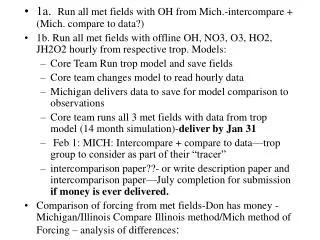
1a. Run all met fields with OH from Mich.-intercompare + (Mich. compare to data?) • 1b. Run all met fields with offline OH, NO3, O3, HO2, JH2O2 hourly from respective trop. Models: • Core Team Run trop model and save fields • Core team changes model to read hourly data • Michigan delivers data to save for model comparison to observations • Core team runs all 3 met fields with data from trop model (14 month simulation)-deliver by Jan 31 • Feb 1: MICH: Intercompare + compare to data—trop group to consider as part of their “tracer” • intercomparison paper??- or write description paper and intercomparison paper—July completion for submission if money is ever delivered. • Comparison of forcing from met fields-Don has money -Michigan/Illinois Compare Illinois method/Mich method of Forcing – analysis of differences:
1c. Run with AEROCOM phase 2 sources and provide off-line aerosol optical depth calculation—CORE team uses MI optical depth calculation—timeline depends on AEROCOM source specification?? • 1d. Give data set for microphysics tests to Goddard for web site-MI/AER end of month • Debra provides benchmark AER results with Fitzgerald nucleation and Vehkemaeki scheme • Michael provides set of plots that he’s done • 1e. Develop GMI version of FVGCM met fields with full fields in trop + strat fields; Mich to specify fields to save; Steenrod responsible for getting data
2. Core Team: Run aircraft surface soot for 4 met fields: • Different scavenging and sedimentation for varying size (deposition coefficient may be size dependent) • Parametric study of aircraft soot accumulation varying emissions from 9-11, 11-13, 13-15 • Start Feb 1 – 16 runs completed in 2 month 5 – 7 years each • Begin analysis on Mar 1; Paper by Aug 2004 • Sea salt and dust sources based on met fields, DMS??—put off • or
3. Core team: Begin addition of UMaer Microphysics—start Mar 1, 2004- Mar 2005 • 3-4 months to install in 4 met fields + run 1 year • June1 - MI – begin analyze results – 3 –4 months-report in Nov 2005; Compare microphysics in 4 different met fields • Paper comparing use of UMaer model with 4 met fields Documentation + uncertainty due to met fields—Mar 05 to complete
Jun 1 2004, CORE team to add OCS to model-with AER • CORE team adds AER microphysics to GMI (hybrid with UMaer BC,OC, SS, Dust)-start implementation in July 2004, include aircraft sources • Runs ready in Dec. 2004, Analysis Jan – May 2005 (Debra lead-help from Mich)—paper comparing AER microphysics and UMaer microphysics by Dec 2005 for stratosphere + troposphere + effects of aircraft
Scavenging sensitivity study-post doc 2yrs • Compare Harvard scheme with scheme that uses full precipitation and cloud fields (have from CCM3) • Study other models and prepare scavenging scheme consistent with other treatments • Do for all aerosols and radionucleides with Considine