Understanding Muscular Dystrophy: Symptoms, Inheritance, Diagnosis, and Treatments
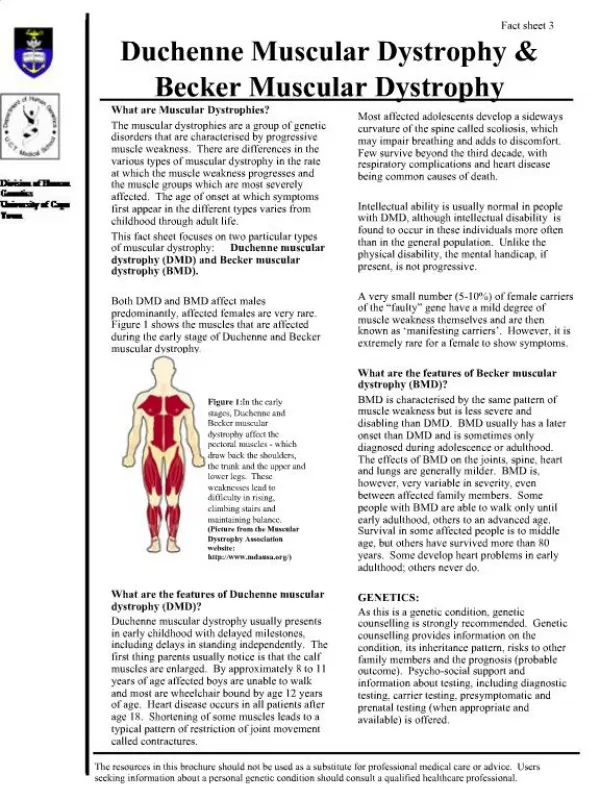
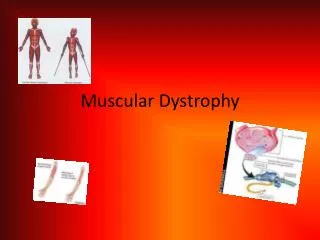
Muscular Dystrophy is a group of more than 30 genetic disorders characterized by progressive muscle weakening and degeneration. Key symptoms include drooping eyelids, increased falls, and loss of muscle size. Inheritance usually involves gene mutations on the X chromosome. Diagnosis is based on genetic testing to identify missing or incorrect genes. While there is no cure, treatments like physical, respiratory, and speech therapy can help manage symptoms. Most cases manifest during teenage years, particularly affecting boys, but some forms may appear at later ages.

Understanding Muscular Dystrophy: Symptoms, Inheritance, Diagnosis, and Treatments
E N D
Presentation Transcript
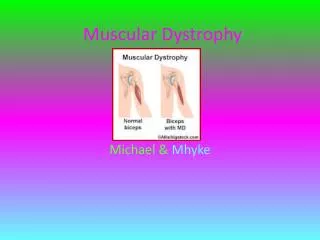
Muscular Dystrophy Michael &Mhyke
Symptoms The symptoms are progressive weakening, breaking down of muscle fibers, drooling, eyelids dropping, frequent falls, loss in muscle size, and problems walking.
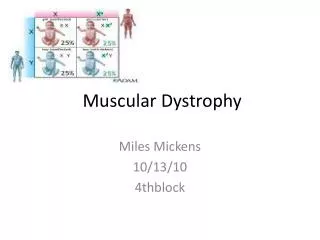
Inheritance of the Disorder It may be running in a family or a changed gene. It’s also located on the X chromosome.
How people are diagnosed They are diagnosed by having incorrect or missing information in their genes.
Treatments There isn’t one main treatment to stop any kind of Muscular Dystrophy, but some treatments are physical therapy, respiratory therapy, and speech therapy.
How common the disorder is The disorder is most common in adult form. It usually begins in the teenage years.
Interesting facts • Muscular Dystrophies are a group of more than 30 genetic disease • Some forms of Muscular Dystrophy are seen in infantry or childhood while others may not appear until middle age or later • Typically boys with Muscular Dystrophy are diagnosed with the disorder • Dystrophin is a protein found in muscle cells • It may have trouble breathing or swallowing
Work Cited "Duchenne and Becker Muscular Dystrophy." - Genetics Home Reference. N.p., n.d. Web. 15 Feb. 2014. <http://ghr.nlm.nih.gov/condition/duchenne-and-becker-muscular-dystrophy>. "NINDS Muscular Dystrophy Information Page." Muscular Dystrophy Information Page: National Institute of Neurological Disorders and Stroke (NINDS). N.p., n.d. Web. 14 Feb. 2014. <http://www.ninds.nih.gov/disorders/md/md.htm>. "Muscular Dystrophy." KidsHealth - the Web's Most Visited Site about Children's Health. Ed. Alisa Clark. The Nemours Foundation, 01 July 2010. Web. 15 Feb. 2014. <http://kidshealth.org/teen/diseases_conditions/bones/muscular_dystrophy.html>.