Download
1 / 16
160 likes | 285 Views
This chapter explores the multifaceted causes of World War I, highlighting nationalism, imperialism, alliances, and military build-up as contributing factors. It details the assassination of Archduke Ferdinand in June 1914, which ignited the conflict, and the subsequent declarations of war among the major powers. As the war unfolded, trench warfare became a hallmark of the gruesome battles fought on the Western Front, characterized by new technologies such as machine guns, tanks, and poison gases. The chapter presents a comprehensive overview of the early stages of this global conflict.

E N D
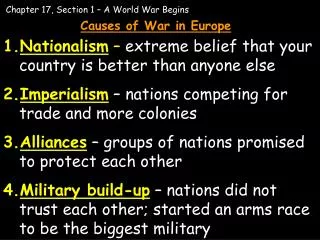
Chapter 17, Section 1 – A World War Begins Causes of War in Europe • Nationalism – extreme belief that your country is better than anyone else • Imperialism – nations competing for trade and more colonies • Alliances – groups of nations promised to protect each other • Military build-up – nations did not trust each other; started an arms race to be the biggest military
The Spark • Austria-HungaryEmpire was made up of many differentethnic groups • Bosniawas controlled by Austria-Hungary • Serbsliving in Bosnia wanted to belong to the Nation ofSerbia • This is an example ofNationalism
Archduke Ferdinandwent toSarajevo(in Bosnia)in June 1914 • Part of a visit dealing with the annexation of Serbia by Austria-Hungary • While there, he isassassinatedby a Serbian terrorist (Gavrilo Princip) This is an example ofImperialism Video Clip
Austria-Hungary declares war onSerbia • Russia(ally of Serbia) declares war on Austria-Hungary • Germany(ally of Austria-Hungary) declares war on Russia (Triple Alliance) • EnglandandFrance(ally of Russia) declare war on Germany (Triple Entente) Interactive map
Central Powers and Allied Powers Central powers Germany, Austria-Hungary, Ottoman Empire, and Bulgaria Allied powers Great Britain, France, and Russia(Italyjoins in 1915;the U.S.joins in 1917)
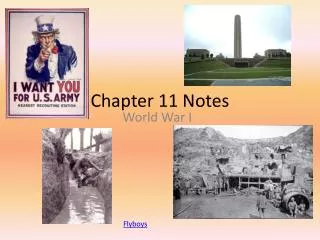
Trench Warfare • Both sides began todig trenchesin an attempt tohold onto territory • trenches stretched forhundreds of milesalong the Western Front • millions of soldierswould live and die in these muddy ditches
The war was fought on theland, thesea, and in theair • main battleground wasEurope • the longest fighting took place on theWestern Front(France and Belgium) • Both sides hoped fora quick endto the fighting – but by theend of 1914, there was astalemate
Between the trenches of each side was known as“no man’s land” • in order to attack, soldiers had tocrawl outandcross over“no man’s land” • Battle atSomme Riverlasted for 4 months • more than1 millionsoldiers were killed and/or wounded • neither side coulddefeat the other
New Weapons of War • World War I saw the use of many newweapons of destruction • machine gun– could fire up to600bulletsper minute • tanks–“bulletproof”; could crawl overobstacles and trenches • submarines– could secretly attack and sinkships
airplanes– observation;strategicbombing; naval warfare • poison gases– used to overcome the stalemate oftrenchwarfare • chlorine • phosgene • mustard gas • Casualties From Gas - The Numbers • Country Total Casualties Death • Austria-Hungary 100,000 3,000 • British Empire 188,706 8,109 • France 190,000 8,000 • Germany 200,000 9,000 • Italy 60,000 4,627 • Russia 419,340 56,000 • USA 72,807 1462 • Total1,230,853 90,189
Key • Communication Trench • Machine Gun Nest • Underground Bunker • Traverse • Wire Break • Listening Post • + Trench Block