Download
1 / 3
30 likes | 141 Views
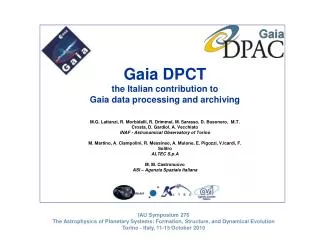
This poster presents Italy's significant role in the ESA Gaia mission, scheduled for launch in October 2012 with a five-year project lifespan. The mission's key challenge focuses on data reduction, managed by a consortium known as DPAC, consisting of various European research institutions. The DPCT center in Turin plays a pivotal role, hosting the Astrometric Verification Unit (AVU) to ensure instrument accuracy throughout the mission. Additionally, DPCT will operate systems for detecting gravitational effects from Jupiter's mass and maintain an Initial Gaia Source List, showcasing the collaboration between Italian research and industry.

E N D
Gaia DPCT the Italian contribution to Gaia data processing and archiving M.G. Lattanzi, R. Morbidelli, R. Drimmel, M. Sarasso, D. Busonero, M.T. Crosta, D. Gardiol, A. Vecchiato INAF - Astronomical Observatory of Torino M. Martino, A. Ciampolini, R. Messineo, A. Mulone, E. Pigozzi, V.Icardi, F. Solitro ALTEC S.p.A M. M. Castronuovo ASI – Agenzia Spaziale Italiana IAU Symposium 276 The Astrophysics of Planetary Systems: Formation, Structure, and Dynamical Evolution Torino - Italy, 11-15 October 2010
Gaia DPCT The poster shortly presents one of the Italian Contribution to the ESA Gaia mission, to be launched around October 2012, with a planned lifetime of 5 years. One of the major challenge of the mission is related to the overall data reduction that is currently under the development responsibility of a consortium called DPAC constituted by a large number of European research institutions. • The overall data processing is distributed among 6 different centers: • DPCE at ESAC in Spain, • DPCB in Barcelona, • DPCC at CNES, • DCPG in Geneve, • DPCI in Cambridge • DPCT at the ALTEC centre in Turin. IAU Symposium 276 The Astrophysics of Planetary Systems: Formation, Structure, and Dynamical Evolution Torino - Italy, 11-15 October 2010 DPAC Structure
Gaia DPCT • The primary role of the DPCT is to host and operates the Astrometric Verification Unit (AVU) which is a critical component for: • the verification of the instruments behavior along the mission lifetime and their impacts on the received data (BAM and AIM) • the verification through an independent method (GSR) of the astrometric data processing performed with the baseline process (AGIS) at ESAC/DPCE • DPCT will host also: • the GAREQ system that will process instruments data to detect light deflection due to quadrupole components of the Jupiter mass. • the Initial Gaia Source List (IGSL) DB that provide regurarly updates to DPCE on reference sources. • The DPCT development and operation is a joint effort betwen the science team of the Astronomical Observatory of Torino and the ALTEC industry team, in charge of providing the overall HW, SW infrastructure and DB required for running the scientific SW components IAU Symposium 276 The Astrophysics of Planetary Systems: Formation, Structure, and Dynamical Evolution Torino - Italy, 11-15 October 2010 DPAC Structure