Entanglement sampling and applications
160 likes | 266 Views
This work explores the interplay between entanglement and uncertainty relations in quantum games, particularly focusing on scenarios involving an adversary (Eve) and a quantum state (Alice). Collaboratively authored by Omar Fawzi, Frédéric Dupuis, and Stephanie Wehner, the research demonstrates that at least half of the quantum memory is necessary for maximizing guessing probability (Pguess). The findings have implications for two-party cryptography and secure computation, highlighting the significance of entanglement and new uncertainty relations to enhance security in quantum communications.


Entanglement sampling and applications
E N D
Presentation Transcript
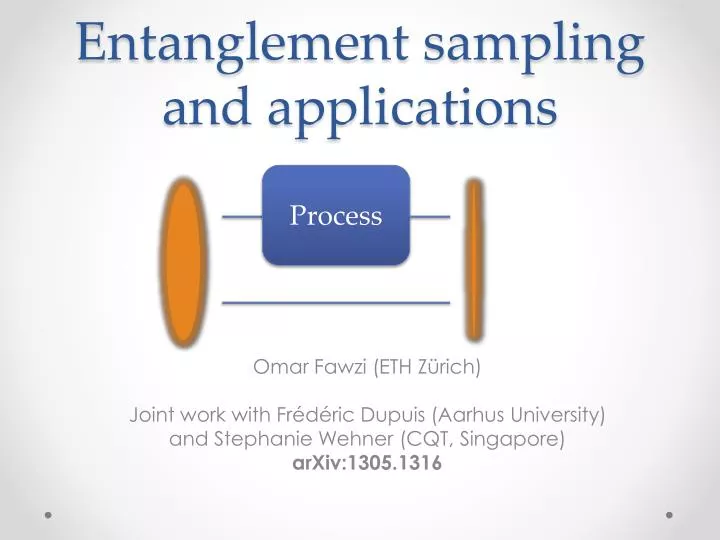
Entanglement sampling and applications Process Omar Fawzi (ETH Zürich) Joint work with FrédéricDupuis (Aarhus University) and Stephanie Wehner (CQT, Singapore) arXiv:1305.1316
Uncertainty relation game Eve Alice Choose n-qubit state Choose random EVE … Choose n-qubit state X1 Xn X2 Xn-1 Choose random Guess X Maximum ? … X1 Xn X2 Xn-1 Guess X Maximum Pguess?
Uncertainty relation game • Can Eve do better with different ? • No [Damgard, Fehr, Salvail, Shaffner, Renner, 2008] Measure in X Guess X Between 0and n Notation:
Uncertainty relations with quantum Eve Eve has a quantum memory A Measure in E X Guess X using E and Maximum ? [Berta, Christandl, Colbeck, Renes, Renner, 2010]
Uncertainty relations with quantum Eve Measure in A X E Measure in X
Uncertainty relations with quantum Eve E.g., if storage of Eve is bounded? Uncertainty relation + chain rule using maximal entanglement Converse Is maximal entanglement necessary for large Pguess? Main result: YES At least n/2 qubits of memory necessary
The uncertainty relation E=X between –n and n Max entangled Max entangled • Measure for closeness to maximal entanglement • Log of guessing prob. between 0 and n
The uncertainty relation Max entanglement
General statement X C More generally: Gives bounds on Q Rand Access Codes Meas in Θ M A A Example: E E
Applicationtotwo-party cryptography ?? ?? “I’m Alice!” password Stored password Equal? Malicious ATM: tries to learn passwords Yes/No Malicious user: tries to learn other customers passwords
Application to secure two-party computation • Unconditional security impossible [Mayers 1996; Lo, Chau, 1996] • Physical assumption: bounded/noisy quantumstorage [Damgard, Fehr, Salvail, Schaffner 2005; Wehner, Schaffner, Terhal 2008] • Security if Using new uncertainty relation • Security if n: number of communicated qubits
Proof of uncertainty relation Step 1: X Conditional state Meas in Θ A E
Proof of uncertainty relation Step 2: Write by expanding in Pauli basis
Proof of uncertainty relation Relate and Observation 1: Not good enough
Proof of uncertainty relation Relate and Observation 1: Observation 2: Combine 1 and 2 done!
Conclusion • Summary • Uncertainty relation with quantum adversary for BB84 measurements • Generic tool to lower bound output entropy using input entropy • Open question • Combine with other methods to improve? ?