Download
1 / 13
130 likes | 248 Views
This presentation explores the unique security challenges faced by distributed wireless sensor networks, emphasizing cryptographic techniques to protect sensitive data. Key topics include the nature of security attacks, privacy issues for individual sensors, and the dynamic establishment of hierarchical structures among nodes. We discuss specific sensor-related attacks and propose adaptive security measures based on information content and energy availability. Additionally, we highlight ongoing research in optimizing energy use while ensuring robust security through advanced cryptographic methods.

E N D
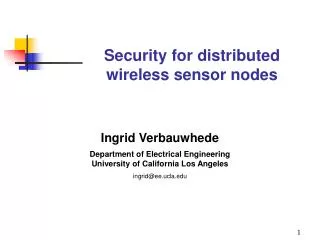
Ingrid Verbauwhede Department of Electrical EngineeringUniversity of California Los Angeles ingrid@ee.ucla.edu Security for distributedwireless sensor nodes
Outline • Motivation • Security attacks • What is different, special to sensor networks • Links to other security problems • Topics of research
Motivation • security problems & cryptographic techniques • to protect them. • Privacy for individual sensors: depends • tank passes in a battlefield: not really needed • individual hart beats of patients: not much information • at home: sensor tells me that the jacuzzi is ready: not much information • Authentication for individual sensors: for sure • don’t want the enemy to inject false alarms on tank locations • don’t want to adjust the insulin level of the wrong patient • don’t need to know that my neighbor’s jacuzzi is ready
Sensor specific attacks ? Almost every attack to a sensor node has an equivalent in a regular network, or in radio communication. Main difference = energy drainage instead of performance drop
Research approach • Adapt security level to information content! • Combine with distributed computing • Assume a hierarchical structure
Super node Intermediate nodes Leaf nodes: > 10K, 100K Hierarchy of nodes Hierarchy established dynamically, depending application or circumstances
Assumptions • Distributed network of heterogeneous nodes • (different types of sensors, different levels of processing capabilities) • nodes establish at hoc connections • Assume the existence of a hierarchy of nodes, with • hierarchy is dynamically established • hierarchy might change depending on application, power budget • the higher up in the hierarchy, the more energy is available and • the higher the security level • if an intermediate node is compromised, the tree below it will be.
Hierarchy of security Security requirement Energy availability Trust Level: Information content: unlimited highest highest Top Distributed optimization Medium Medium Medium Low Low • Low processing: • feature extraction • motion detection Low Extremely low None to low Assume zero, Build up • Extremely low • Short messages • Small set of possibilities • Yes/no or Red/green/blue
Cryptographic techniques • Between Levels: • Challenge response system (i.e. communication initiated by • the higher level) • to avoid denial-of-service (energy drainage) • Communication versus computation! • A: challenge (includes time factor, randomness) • B: response • C: verify response • Response could contain requested information since • possible answers are from limited set. • Requires one-way hash function or encryption in leaf nodes. • Requires two radio transmissions per leaf node! C A B
Cryptographic techniques (cont.) • At intermediate levels: • Set up “conference key”, • Combine with distributed computations & optimizations Energy Computations, Energy Radio, Energy Security • Example: Burmester-Desmedt conference key protocol: • exponentiation zi • broadcast zi • exponentiation, Xi = f( zi-1, zi+1) • broadcast Xi • exponentiation, compute K = f(zi, Xi)
Inference Control in database Sensor data (similar to a “mystery box”) • It is yellow • It does not make noise • It turns its head towards the sun • Individual sensors: not much information content • Data fusion: information extraction • If the good guys can , so can the “bad” guys. • Inference control in data bases (1980’s): • allow statistical data extraction • protect privacy of individuals • e.g. medical or employee data bases • add noise or restrict access
Conclusions: • Individual tasks similar/related to existing problems • Combination of these tasks unique to sensor networks • Current activities: • Power security trade-off • Measure of security for energy budget • co-processors for low power encryption • Cryptographic techniques with minimal communication overhead
Numbers • RSA on StrongARM: 16 mJ, 65 ms • (encrypt, verify, decrypt, sign) [NAI labs] • Low power encryption hardware: • Quadratic Residue generator [Goodman, 98] • 134mW at 2.5V, 1Mb/s, factor 1000 better than StrongArm • Advanced InfoSec Machine [Motorola] • < 100 mW (at 1.5 MHz)