Matter Classification
This guide explores the fundamental classification of matter at the microscopic level. Matter is composed of atoms, the basic building blocks of all substances. Atoms can bond to form molecules, either of the same element or of different elements. Pure substances cannot be separated by physical means, while mixtures can. We categorize matter into elements, compounds, homogeneous mixtures, and heterogeneous mixtures, highlighting their unique characteristics and separation methods. Practice classifying various substances to reinforce your understanding.

Matter Classification
E N D
Presentation Transcript
Microscopic Scale • Atom – building block of all matter • Molecule – two or more atoms chemically bonded together
Microscopic Scale Atom The smallest unit of an element Ex) Na, Mg, Fe, Ar, Zn, Cu Molecule of element Same element chemically bonded Ex) H2, O2, N2, F2, Cl2, Br2, I2, S8 Molecule of compound Different elements chemically bonded Ex) H2O, CO2, HCl, CH2O
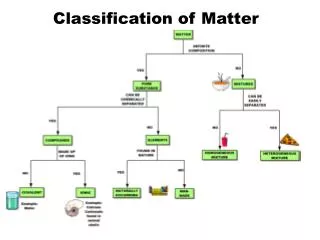
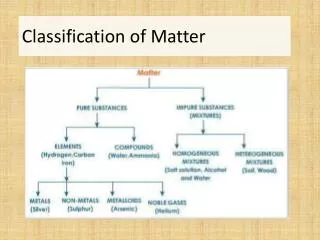
Matter YES NO Can it be separated by physical means? Mixtures Pure Substances Can it be separated through chemical reactions? Can it be separated easily? YES YES NO NO Homogeneous Mixture Heterogeneous Mixture Element Compound
Matter – material that has mass and takes up space Matter YES NO Can it be separated by physical means? Mixtures Pure Substances Can it be separated through chemical reactions? Can it be separated easily? YES YES NO NO Homogeneous Mixture Heterogeneous Mixture Element Compound
Matter Pure Substances– can’t be separated by physical means (heating, filtering, sorting, etc.) YES NO Can it be separated by physical means? Mixtures Pure Substances Can it be separated through chemical reactions? Can it be separated easily? YES YES NO NO Homogeneous Mixture Heterogeneous Mixture Element Compound
Matter YES NO Can it be separated by physical means? Mixtures – contains more than one substance Mixtures Pure Substances Can it be separated through chemical reactions? Can it be separated easily? YES YES NO NO Homogeneous Mixture Heterogeneous Mixture Element Compound
Matter YES NO Can it be separated by physical means? Mixtures Pure Substances Can it be separated through chemical reactions? Can it be separated easily? YES YES Element – unique type of atom; on the Periodic Table NO NO Homogeneous Mixture Heterogeneous Mixture Element Compound
Matter YES NO Can it be separated by physical means? Mixtures Pure Substances Can it be separated through chemical reactions? Can it be separated easily? Compound – contains more than one element; atoms are chemically bonded together YES YES NO NO Homogeneous Mixture Heterogeneous Mixture Element Compound
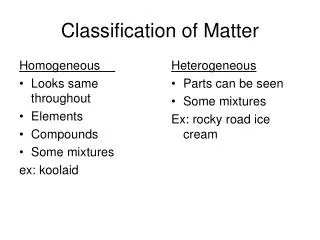
Matter YES NO Can it be separated by physical means? Mixtures Pure Substances Can it be separated through chemical reactions? Can it be separated easily? Homogeneous Mixture – is the same throughout; each sample is identical YES YES NO NO Homogeneous Mixture Heterogeneous Mixture Element Compound
Matter YES NO Can it be separated by physical means? Mixtures Pure Substances Can it be separated through chemical reactions? Can it be separated easily? Heterogeneous Mixture – is not the same throughout; samples are different YES YES NO NO Homogeneous Mixture Heterogeneous Mixture Element Compound
Practice Classifying • Put the following objects in the appropriate category: Element Compound Homogeneous Heterogeneous Mixture Mixture Oreos Root Beer Baking Soda (NaHCO3) Lithium (Li) Hydrogen (H2) Raisin Bran Hydrochloric Acid (HCl) Detergent Gold (Au) Formaldehyde (CH2O) Gatorade Your Body
Practice Classifying-Answers • Put the following objects in the appropriate category: Element Compound Homogeneous Heterogeneous Mixture Mixture Lithium (Li) Baking Soda (NaHCO3) Root Beer Oreos Hydrogen (H2) Detergent Raisin Bran Hydrochloric Acid (HCl) Gold (Au) Gatorade Your Body Formaldehyde (CH2O)