Evolution and Natural Selection
This outline delves into the fundamental concepts of evolution and natural selection, exploring how gene frequency changes occur over time. It highlights key processes such as adaptation, which enhances survival and reproduction, and the mechanisms driving evolution, including natural selection and genetic drift. The framework established by Darwin in 1859 is discussed, emphasizing the importance of trait variation, heritability, and environmental context. Suitable examples illustrate how traits like body size, fur length, and beak shape adapt to their environments, paving the way for a deeper understanding of evolutionary biology.

Evolution and Natural Selection
E N D
Presentation Transcript
Evolution and Natural Selection March 19, 2013
Outline • What is evolution? • What is natural selection? • What is adaptation? • Natural selection simulation
1. What is evolution? • Change (in gene frequency) over time Change over time Gene frequency in population
1. What is evolution? • “Time” means many generations Examples: • Humans = 1,000,000 years • Birds = 30 years • Bacteria = hours
1. What is evolution? • Evolution can occur in different ways • Natural selection • Genetic drift (randomness) • Migration between populations
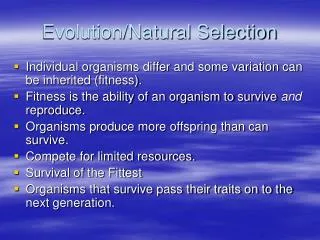
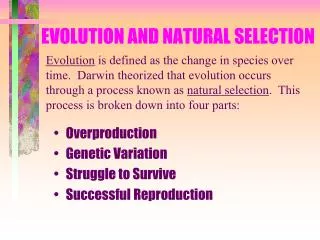
2. What is natural selection? • A mechanism of evolution • Theorized by Darwin in 1859 • Not all organisms will survive and reproduce • Some traits get passed on and others don’t
2. What is natural selection? • Three components: • Variation in a trait among individuals in a population
2. What is natural selection? • Three components: • Variation in the trait is heritable
2. What is natural selection? • Three components: • That variation affects an individual’s ability to survive and reproduce
3. What is adaptation? • A trait that increases an individual’s ability to survive and reproduce
3. What is adaptation? • Whether or not a trait is adaptive often depends on the environment
Trait List • Fat body / skinny body • Long fur / short fur • Long legs / short legs • Stripes / spots • Large beak / small beak • Claws / hoof • Head crest / neck crest
http://science.discovery.com/games-and-interactives/charles-darwin-game.htmhttp://science.discovery.com/games-and-interactives/charles-darwin-game.htm