Download
1 / 18
190 likes | 323 Views
This document presents an in-depth analysis of genericity in the Eiffel programming language, focusing on its syntax, motivations, and implications for type safety. It explains the common issues encountered in type declarations and presents an improved approach through parameterized classes. This includes a comprehensive examination of classes such as `LIST_OF_CARS` and `LIST_OF_CITIES`, alongside practical examples demonstrating the application of generics. It also highlights the importance of the DRY principle (Don't Repeat Yourself) and discusses how static and dynamic types interact within generic structures.

E N D
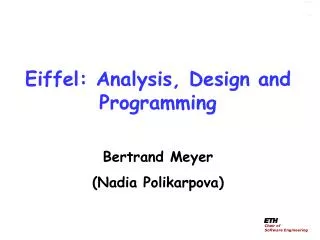
Eiffel: Analysis, Design and Programming Bertrand Meyer (Nadia Polikarpova) Chair ofSoftware Engineering
- 7 - Genericity
Overview • Motivation • Syntax • Type safety • The notion of type
What’s wrong with this code? • classLIST_OF_CARSfeature • extend (v: CAR)is… • remove (v:CAR)is… • item:CARis… • end classLIST_OF_CITIESfeature extend (v:CITY)is … remove (v:CITY)is … item:CITYis … end
What’s wrong with this code? • classLIST_OF_CARSfeature • append (other: LIST_OF_CARS) • do • from other.startuntil other.afterloop • extend(other.item) • end • end • end • classLIST_OF_CITIESfeature • append (other : LIST_OF_CITIES) • do • from other.start until other.after loop • extend(other.item) • end • end • end DRY Principle: Don’t Repeat Yourself
Possible approaches for containers • 1. Duplicate code, manually or with help of macro processor. • 2. Wait until run time; if types don’t match, trigger a run-time failure. (Smalltalk) • 3. Convert (“cast”) all values to a universal type, such as “pointer to void” in C. • 4. Parameterize the class, giving an explicit name G to the type of container elements. This is the Eiffel approach, now also found in Java (1.5), .NET (2.0) and others.
Genericity solution to LIST_OF_... • classLIST [G] feature • append (other: LIST [G] ) do • do • from other.startuntil other.after loop • extend (other.item) • end • end • end • city_list: LIST[CITY] • car_list: LIST[CAR]
A generic class Formal generic parameter • classLIST[ G ]featureextend (x : G )... last : G ... end • To use the class: obtain a generic derivation, e.g. • cities: LIST [ CITY ] Actual generic parameter
Genericity: ensuring type safety • How can we define consistent “container” data structures, e.g. list of accounts, list of points? • Without genericity, something like this: • c : CITY ; p : PERSONcities : LIST ... • people : LIST ... • --------------------------------------------------------- • people.extend () • cities.extend ( ) • c := cities.last • c.add_road What if wrong? p c
Static typing • Type-safe call (during execution): A feature call x.fsuch that the object attached to x has a feature corresponding to f [Generalizes to calls with arguments, x.f(a, b) ] • Static type checker: A program-processing tool (such as a compiler) that guarantees, for any program it accepts, that any call in any execution will be type-safe • Statically typed language: A programming language for which it is possible to write a static type checker
Using generic derivations • cities : LIST [CITY] • people: LIST [PERSON] • c : CITY • p: PERSON... • cities.extend (c) • people.extend (p) • c := cities.last • c.add_road • STATIC TYPING • The compiler will reject: • people.extend (c) • cities.extend (p)
Types • LIST [CITY ] • LIST [LIST [CITY ]] • … • A type is no longer exactly the same thing as a class! • (But every type remains based on a class.)
Definition: Type • We use types to declare entities, as in x: SOME_TYPE • With the mechanisms defined so far, a type is one of: • A non-generic class e.g.METRO_STATION • A generic derivation, i.e. the name of a class followed by a list of types, the actual generic parameters, in brackets (also recursive) e.g. LIST [ARRAY [METRO_STATION]] • LIST [LIST [CITY ]] • TABLE[STRING, INTEGER]
So, how many types can I possibly get? • Two answers, depending on what we are talking about: • Static types • Static types are the types that we use while writing Eiffel code to declare types for entities (arguments, locals, return values) • Dynamic types • Dynamic types on the other hand are created at run-time. Whenever a new object is created, it gets assigned to be of some type.
Static types • classEMPLOYEE • feature • name: STRING • birthday: DATE • end • classDEPARTMENT • feature • staff: LIST [EMPLOYEE] • end bound by the program text: EMPLOYEE STRING DATE DEPARTMENT LIST[G] becomesLIST[EMPLOYEE]
Object creation, static and dynamic types • classTEST_DYNAMIC _CREATION • feature • ref_a: A; ref_b: B • -- Suppose B, with creation feature make_b, • -- inherits from A, with creation feature make_a • do_something • do • createref_a.make_a • -- Static and dynamic type is A • create{B} ref_a.make_b • -- Static type is A, dynamic type is B • end • end
Dynamic types: another example • classSET[G]feature • powerset:SET[SET[G]] is • do • createResult • -- More computation… • end • i_th_power (i: INTEGER):SET[ANY] • require i >= 0 • local n:INTEGER • do • Result:=Current • fromn := 1 untiln > iloop • Result:=Result.powerset • n := n + 1 • end • end • end Dynamic types fromi_th_power: SET[ANY] SET[SET[ANY]] SET[SET[SET[ANY]]] … From http://www.eiffelroom.com/article/fun_with_generics
Genericity: summary • Type extension mechanism • Reconciles flexibility with type safety • Enables us to have parameterized classes • Useful for container data structures: lists, arrays, trees, … • “Type” now a bit more general than “class”