Download
1 / 33
330 likes | 457 Views
Join us for an engaging workshop focused on continuous improvement strategies in educational settings. Participants will introduce themselves and collaborate on goal-setting tactics utilizing the SMART framework (Specific, Measurable, Attainable, Results-oriented, Time-bound). We’ll delve into data analysis to identify key improvement areas, develop classroom and student goals, and discuss methods for aligning these goals with school improvement plans. Together, we’ll create actionable SMART goals tailored to enhance student proficiency and foster a constructive learning environment.

E N D
The Continuous Improvement Classroom Day 210-9-06
Introductions and Welcome! • At your table… • Introduce yourself (Name, location, position) • Participant Materials; • Handout Materials • Goal setting packet / 1 per table • Process & Tools Training- Pocket Tools
The Continuous Improvement Classroom Goal Setting
What Are The “Big Rocks”… • In our school district? • At your school? • In your classroom?
Measurable Goals • Goals provide focus on continuous improvement (classroom & personal goals) • Goals are developed with student input: • Based on data • Aligned to the SIP
Day 2- Worksheet A Goal Setting PacketReview and discuss at your table…
Why SMART Goals? • Goals are something that you want to achieve in the future • SMART goals assist in “getting focused” on what to focus efforts toward • SMART goals help define exactly what the “future state” looks like and how it will be measured • The Test: If all you did was spend time on the identified SMART goals, the time be well-spent
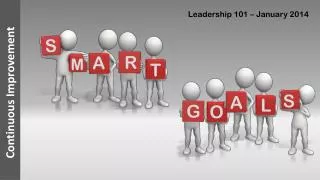
What Are SMART GOALS? • S pecific, strategic • M easurable • A ttainable • R esults-oriented • T ime-bound
How To Write SMART Goals • Identify the “big, hairy audacious, critical-few” goals that need to be worked on (The Most Important Ones!) • Consult the data! • What are the greatest areas in need of improvement? • Dig deep and get specific (disaggregate!)
ITBS Language Total Scores This data shows “the big picture” of language proficiency …
This data “digs deeper” through sub test areas of language skills…
This data “digs deeper through disaggregation” of student subgroup population proficiency …
Subgroups: • African American • American Indian • IEP • Low Income
SMART Goal Conclusion… • During the 2006-07 school year, SAMPLE school will increase students’ proficiency in vocabulary skills in the non-proficient student subgroups as measured by the ITBS vocabulary sub test assessment (See targets below for each non-proficient sub group)
During the 2006-07 school year, Sample School will increase the respect shown by students as measured by a 15% reduction in office referrals due to “disrespect.” During the 2006-07 school year, Sample School will increase the respect shown by students. We will work on reducing office referrals.
Kid Friendly & Focused • I want to improve math… Vs. • This year, I want to increase my skills in math problem solving as measured by a 10% increase on the monthly chapter tests.
SIP SMART Vs. Kid Friendly? • Original SIP SMART Goal: During the 2006-07 school year, SAMPLE school will increase students’ proficiency in vocabulary skills in the non-proficient student subgroups as measured by a 10% increase in the ITBS vocabulary sub test assessment • Classroom SMART Goal (Kid Friendly): This year, Mr. Marino’s 3rd grade class will have a better understanding of words as measured by a 10% reduction in vocabulary errors in weekly writing assignments.
Classroom SMART Goal (Kid Friendly): This year, Mr. Marino’s 3rd grade class will have a better understanding of words as measured by a 10% reduction in vocabulary errors in weekly writing assignments. • Student Goal (in data folder): This year, I will focus on getting better at learning the meaning of words. I will measure how I’m doing by keeping track of the number of errors I have in vocabulary usage on the weekly writing prompts we do in class.
Try It Out! • As a table, write a SMART goal that relates to your efforts in continuous improvement this week • Then, each person writes a SMART goal for their classroom (related to their own school’s improvement plan)