GPU-based Distributed Behavior Models with CUDA
This presentation explores GPU-based distributed behavior models utilizing CUDA to simulate flocking behaviors inspired by Reynolds' "boids" algorithm. The models enable the management of large groups through simple local interactions, facilitating the simulation of complex collective motions. Key implementations include neighbor data handling via fragment programs, synchronized motion aggregation, and customizable flock behavior influenced by individual "personality" profiles. Future work aims to enhance these models with advanced neighbor search algorithms and improved data structures for more efficient collective behavior simulations.

GPU-based Distributed Behavior Models with CUDA
E N D
Presentation Transcript
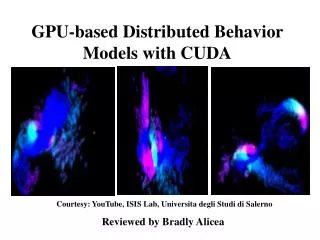
GPU-based Distributed Behavior Models with CUDA Courtesy: YouTube, ISIS Lab, Universita degli Studi di Salerno Reviewed by Bradly Alicea
Introduction Flocking: Reynolds “boids” algorithm. * models simple local behaviors (large # of elements). * need to manage aggregate motion of elements. Related work: * Navier-Stokes equations (simulation of physical flows). * robot motion planning. * ray tracing (computer graphics). Implementation: * information about neighbor elements = stream data. * implemented as fragment programs. * discrete simulation (behavioral and graphics).
Local parameters, data handling Cellular Automata-like: * coupled-map lattice. Space partitioning data structure (CPU): • gather data on neighbors. 2) update at every frame (movement). • Synchronized aggregated motion of flocks: • 1) fix one or more spatial goals (containment, obstacle avoidance). • 2) leader following (whoever the leader is, determines where flock goes).
Data architecture Left: architecture of behavior. “Personality” (profile of each boid) blended and determines global parameters. Below: scattering matrix. Extracts global parameters from “uniform shape”.
Program Structure GPU: runs fragment programs, can use “stream process” * stream data arranged as textures. * handles scene rendering, updates. CPU: used for spatial sorting only. Four textures: Tc = constant texture (global scalars – max. velocity, max. acceleration). To = orientation (3 scalar variables – forward, side, up). Tp = position (3 scalar values – x,y,z). Tn = nearest-neighbors (von Neumann neighborhood).
Larger Context Why do we care about flocking? Models of complex, collective behavior (e.g. traffic modeling) * local interactions, global order parameters. Analogue for emergent processes (e.g. order from chaos, self-organized behavior) * physical processes (B-Z reactions, morphogenesis). Models of autonomous, interactive systems (e.g. social, comunication networks) * local interactions (connectivity) contributes to global properties (stability). Future work: * extend to other implementations of k-nearest neighbors search algorithm. * use scattering matrix, allows for position updates without centralized coordination.