
### Finding Equations of Parallel and Gradient Lines in Linear Graphs ###
Explore how to determine the equations of lines parallel to a given line and those that pass through specific points with designated gradients. This guide covers examples such as finding the equation of a line parallel to y = 3x + 1 that goes through the point (2,3), as well as deriving the equations for lines passing through points (1,4) and (1,3) with gradients of 2. Learn step-by-step methods to calculate and verify the results in linear graph equations. ###

### Finding Equations of Parallel and Gradient Lines in Linear Graphs ###
E N D
Presentation Transcript
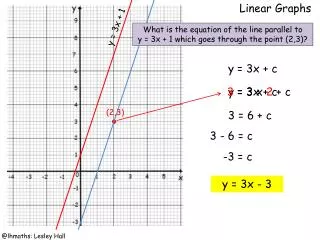
Linear Graphs y = 3x + 1 What is the equation of the line parallel to y = 3x + 1 which goes through the point (2,3)? y = 3x + c y = 3x + c 3 = 3 x 2 + c (2,3) 3 = 6 + c 3 - 6 = c -3 = c y = 3x - 3
Linear Graphs What is the equation of the line that passes through (1,4) and has a gradient of 2? y = 2x + c y = 2x + c 4 = 2 x 1 + c (1,4) 4 = 2 + c 4 - 2 = c 2 = c y = 2x + 2
Linear Graphs What is the equation of the line that passes through (1,3) and (3,7)? (3,7) 7 - 3 gradient = = 2 3 - 1 4 y = 2x + c y = 2x + c 7 = 2 x 3 + c (1,3) 4 = 2 7 = 6 + c 2 7 - 6 = c 1 = c y = 2x + 1