Mastering Present Tense Conjugation of Stem-Changing Verbs in Spanish
This lesson focuses on the conjugation of stem-changing verbs in the present tense. Learn how to memorize the conjugations for verbs that change e→ie or o→ue. Discover how to use the verb "empezar a" followed by an infinitive to express beginnings of actions. Engage in interactive exercises to fill in blanks with possessive adjectives and practice verb conjugations through practical examples. By the end, you will confidently conjugate common stem-changing verbs and understand their usage in sentences.

Mastering Present Tense Conjugation of Stem-Changing Verbs in Spanish
E N D
Presentation Transcript
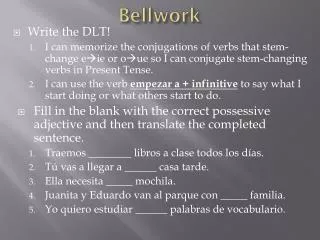
Bellwork • Write the DLT! • I can memorize the conjugations of verbs that stem-change eie or oue so I can conjugate stem-changing verbs in Present Tense. • I can use the verb empezar a + infinitive to say what I start doing or what others start to do. • Fill in the blank with the correct possessive adjective and then translate the completed sentence. • Traemos ________ libros a clase todos los días. • Tú vas a llegar a ______ casa tarde. • Ella necesita _____ mochila. • Juanita y Eduardo van al parque con _____ familia. • Yo quiero estudiar ______ palabras de vocabulario.
Chapter 5 Grammar I Stem-Changing Verbs
Present Tense (Repaso) • Present tense is used to describe actions that occur in the Present • I run • I am running • I do run • Do I run? • Every verb in Spanish has a stem followed by an ending. • The stem is everything before the ending and tells the verb’s meaning. The ending in Spanish can tell you who is the subject. The infinitive ending doesn’t name a subject. • Cantar to sing • Canto I sing • Cantamos we sing
Present Tense(Repaso) • To conjugate a verb means to change the verbs from the infinitive form to match the subject. • To conjugate a verb in Spanish in Present Tense: • Drop the ending from the infinitive (the –ar, -er, or –ir) • Add the ending that matches the particular subject • The following slide will show all the present tense endings…
Present tense(Repaso) • Since the ending of the verb can tell the subject, the subjects for yo, tú, nosotros, & vosotros can be omitted because their verb endings ONLY match their subjects. • These subjects or their subject pronouns can be added to emphasize or clarify who is being talked about. • Ana y yocantamos. (Ana & I sing) • Cantamos. (We sing)
Present tense(Repaso) • The subjects usted, él, and ella share the same ending and the subjects ustedes and ellos share the same endings. • As a result, the subject MUST be used to clarify! • Cantan (They sing or you sing) • Elloscantan. (They sing) • Ana y ustedcantan. (Ana and you sing)
Stem-Changing Verbs • Some verbs have vowel variations in their stems (the part of the verb before the –ar, -er, or –ir) and are called stem-changing verbs. • You have already learned jugar where the u changes to ue, and the verbs querer, tener, andvenir where theechanges toie. • Stem-changing verbs still use the regular –ar, -er, and –ir endings. • The verbs froms for nosotros and vosotros do NOT stem-change.
Common o;ueStem Changing Verbs • Jugar (u;ue) • Dormir • Almorzar • Volver • Llover • To play (games/sports) • To sleep • To have lunch • To return (to a place) • To rain • Use the word hasta after the verb dormir to say you sleep until a certain time. • Los domingosdormimoshastalas once. • On Sundays we sleep until 11.
Common e;ieStem Changing Verbs • Empezar • Merendar • Entender • Querer • Tener • Venir • To begin • To have a snack • To understand • To want • To have • To come • You can also use empezara followed by an infinitive to say what you or other start to do. • ¿A quéhoraempiezanatrabajartus padres? • What time do your parents start to work? • Empiezanatrabajar a lasocho de la mañana. • They start to work at 8:00am.
EXIT SLIP • Conjugate the verbs almorzar (o;ue) to have lunch and merendar (e;ie)-to have a snack. • Be sure to write all forms separately and include the English meaning for each one!