Understanding Unit Conversion: A Guide to Dimensional Analysis in Science
In science, converting units is crucial as wrong units lead to incorrect answers. A quantity is defined by a number and a unit, and often, we must convert between different units of measurement. This guide explains the importance of dimensional analysis and how to properly convert values using conversion factors. Through step-by-step examples, learn to convert between various units like inches to feet, miles to meters, and pounds to grams. Mastering these conversions is essential for accurate scientific calculations.

Understanding Unit Conversion: A Guide to Dimensional Analysis in Science
E N D
Presentation Transcript
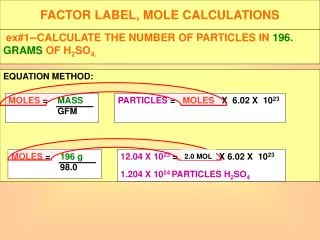
FACTOR LABEL METHOD • In math you use numbers, in chemistry we use quantities. • A quantity is described by a number and a unit. • 100 is a number : 100 Kg is a quantity
Sometimes You Have to ConvertBetween Different Units • How many seconds are in a day? • How many inches are in a centimeter? • If you are going 50 miles per hour,how many meters per second are you traveling? • To answer these questions you need to change (convert) from one unit to another.
What is dimensional analysis? • The converting from one unit system to another. • If this is all that it is, why make such a fuss about it? Very simple. Wrong units lead to wrong answers. Scientists have thus evolved an entire system of unit conversion.
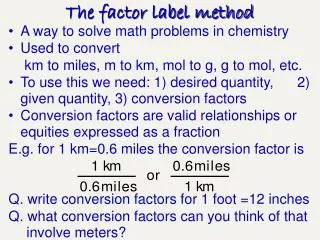
How does it work? • It will involve some easy math (Multiplication & Division) • To perform any conversion, you need a conversion factor. • Conversion factors are made from any two terms that describe the same or equivalent “amounts” of what we are interested in. • For example, we know that: • 1 dozen = 12 • 12 inches= 1 foot • 1 mile= 5280 ft • 1 inch = 2.54 centimeters
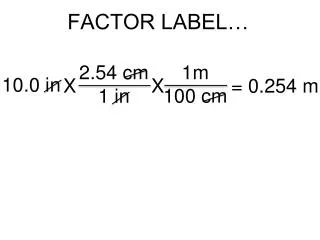
Look at the formula above you will use this solve the problem • 60 inches=__________ ft • Step one what’s your Starting unit? • Inches • What’s your Desired unit? • Feet • What conversion factor are you going to use to convert inches to feet? • 1 foot= 12 inches • Now plug it in!! • 60 inches X 1 foot = 5ft 12 inches
Now Use the formula and Solve these • 73 inches ___________cm • 1779 sec ___________minutes
This is a DIFFERENT FORMULA LOOK!! • 3.5 miles = ________m Step 1 what’s the starting unit? Correct==miles What’s the Desired? feet What are the conversion factors you will use? Look at your conversion sheet? How can we get from miles to Meters? 1 mile= 5280ft AND 1 ft = 0.3048 m Now set it up …..remember Feet will be our linking unit because it’s linking our starting to desired
1 mile= 5280ft AND 1 ft = 0.3048 m • 3.5 miles = ________m • 3.5 miles X _______feet X ________meters = meters • mile feet • Now fill it in with the conversion factors • 3.5 miles X 5280feet X _0.3048meters = 5632.7 meters • 1 mile 1 ft
6 gal= _____ fl oz • (1 gal = 4qts) (1 qt = 32 fl oz) • What is Qts going to be? • Correct Linking !! Now set it up like the top formula?
7 hrs=_______seconds • our conversion factors are going to be • Hours to min then minutes to seconds • 1 hr= 60 min AND 1 min =60 seconds • Set it up
PRACTICE • How many grams in 150 pounds given the conversion factors 1 pound = 0.454 kg and 1 kg = 1000 grams
. How many basketballs can be carried by 5 buses? • · 1 bus = 12 cars · 3 cars = 1 truck · 1000 basketballs = 1 truck
30 oranges = ______pineapples • 1 pear = 2 melons • 2 pineapples= 3 melons • 5 pears= 4 oranges