Download
1 / 13
130 likes | 253 Views
This article delves into the transcription process of the J1 gene, spanning 12K base pairs, focusing on pre-mRNA splicing that leads to the production of various protein isoforms of 200, 150, and 130 amino acids. We investigate how alternative splicing mechanisms contribute to this variability and discuss the probabilities of genetic inheritance using product and sum rules, exemplified through dice rolling scenarios and pedigree analysis. This study exemplifies the complexity of genetic expression and its implications in genetics.

E N D
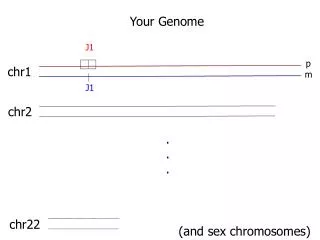
Your Genome J1 p chr1 m J1 chr2 . . . chr22 (and sex chromosomes)
J1 3’ 5’ 5’ 3’ 12K base pair Transcription ? Splicing Translation Protein is 200 Amino Acids
J1 3’ 5’ 5’ 3’ 12K base pair Transcription
J1 3’ 5’ 5’ 3’ 12K base pair Transcription Pre-mRNA (12K bp)
J1 3’ 5’ 5’ 3’ 12K base pair Transcription Pre-mRNA Slicing mRNA AAAAAAAAAAAAAAAAA (~1000 bp)
J1 3’ 5’ 5’ 3’ 12K base pair Transcription Pre-mRNA Splicing mRNA AAAAAAAAAAAAAAAAA (1000 bp) Exons “exit” the nucleus UTR UTR AAAAAAAAAAAAAAAAA 600 bp AUG stop
J1 3’ 5’ 5’ 3’ Transcription Pre-mRNA Splicing mRNA AAAAAAAAAAAAAAAAA Exons “exit” the nucleus UTR UTR (1000 bp) AAAAAAAAAAAAAAAAA AUG stop Translation
We did a protein purification found the following: • J1 of 200 amino acids • J1 of 150 amino acids • J1 of 130 amino acids How is this possible? Pre-mRNA Alternative Splicing mRNA 200 AAs AAAAAAAAAAAAAAAAA or 150 AAs AAAAAAAAAAAAAAAAA or 130 AAs AAAAAAAAAAAAAAAAA
Product rule The probability of two or more independent eventsall occurring (event #1 and event #2 and…) = the product of the individual probabilities Example: what is the probability of throwing dice two times and getting a five each time? = 1/36 1/6 X 1/6
Sum rule The probability of any one of 2 or more mutually exclusive outcomes (outcome #1 or outcome #2 or…) = sum of the individual probabilities Example: what is the probability of throwing dice a single time and getting a six or a four? or = 1/3 1/6 + 1/6
Aa Aa Two events necessary: II-3 must be Aaand they must have aa child A a A a Product rule a = no pigment Example: Albinism… What is the probability that III-1 will be affected? P(II-3 is Aa) = 2/3 P(Aa x Aa giving aa) = 1/4 P(III-1 is aa) = 2/3 x 1/4 = 1/6
Sum rule The same pedigree… What is the probability that III-1 will be homozygous? Need III-1 = AA or aa. Possibilities: Aa father has aa child: 2/3 x 1/4 = 1/6 Aa father has AA child: 2/3 x 1/4 = 1/6 AA father has AA child: 1/3 x 1/2 = 1/6 Therefore, probability of homozygous child = 1/6 + 1/6 + 1/6 = 1/2